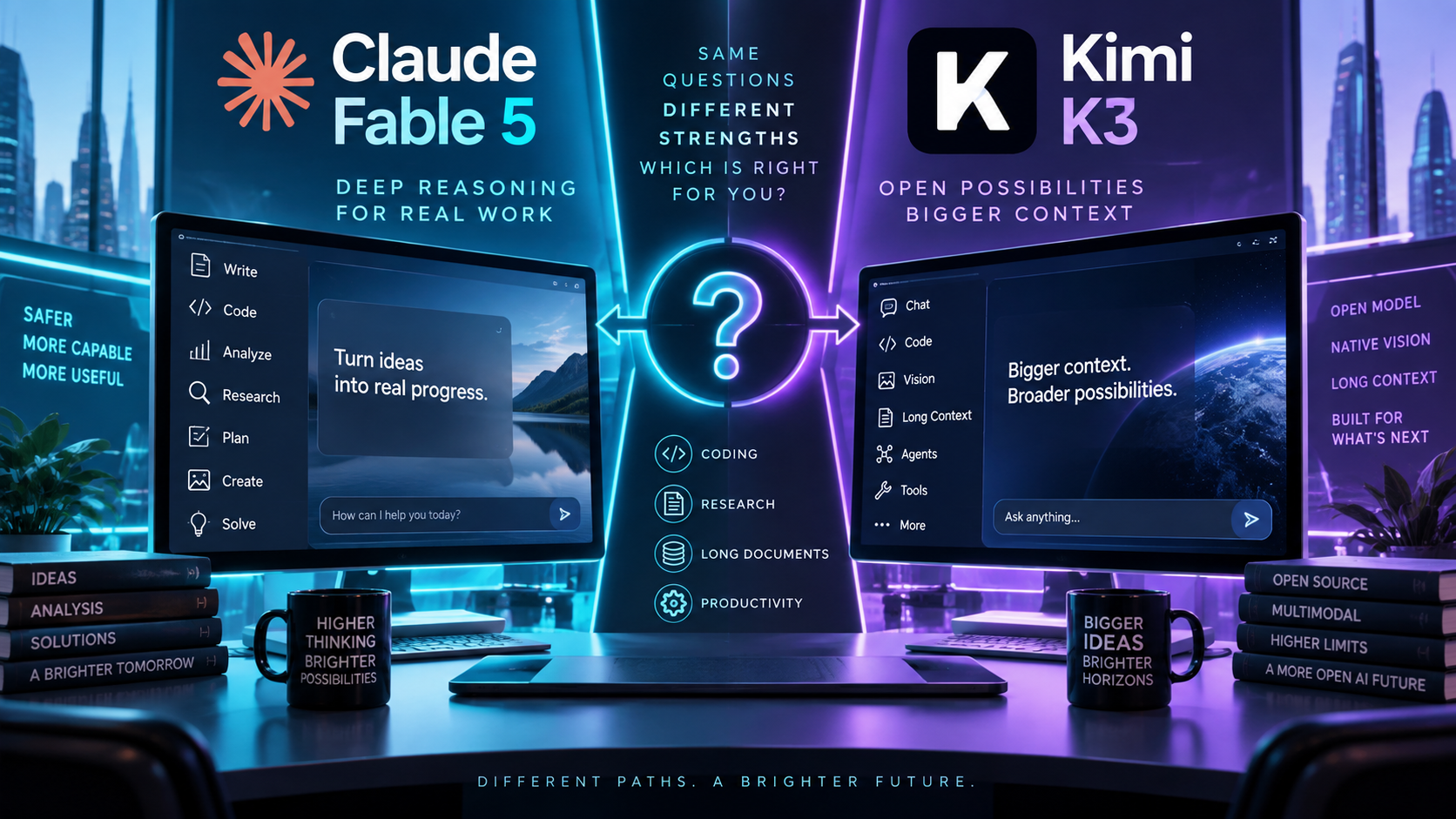
For most users, Claude Fable 5 is the better choice when the priority is maximum reasoning and complex long-horizon work, while Kimi K3 is the more compelling choice if you value open-weight access, native vision and flexibility. Both offer a 1-million-token context window and are designed for demanding AI tasks, but they take very different approaches. If you want to explore the business opportunity around using advanced Claude capability, you can explore Fable Fox AI.
Claude Fable 5 vs Kimi K3: The Key Difference
Claude Fable 5 is Anthropic’s proprietary frontier model for demanding reasoning, coding, knowledge work and long-running agentic tasks. Kimi K3 comes from Moonshot AI and takes a different approach: it is an open-weight 2.8-trillion-parameter model with native vision and a 1-million-token context window.
| Feature | Claude Fable 5 | Kimi K3 |
|---|---|---|
| Primary strength | Complex reasoning and long-horizon agentic work | Open frontier intelligence, coding and agent tasks |
| Context window | 1M tokens | 1M tokens |
| Vision | Yes | Native vision |
| Model type | Proprietary | Open-weight |
| Parameter scale | Not publicly described by Anthropic as a parameter count | 2.8 trillion parameters |
| Best fit | High-end professional and agentic work | Developers, agents and open-model workflows |
Kimi describes K3 as its most capable model, built for long-horizon coding, knowledge work and reasoning. Its official documentation confirms support for up to 1 million tokens of context and native visual understanding.
What Makes Claude Fable 5 Different?
Anthropic designed Fable 5 for what it calls the hardest knowledge-work and coding problems. Its launch materials emphasize software engineering, knowledge work, vision and scientific research, with the model designed to sustain days-long, complex and asynchronous tasks.
That makes Fable 5 particularly relevant when the AI needs to reason through a complicated problem rather than simply answer a question.
Fable 5 also supports a 1-million-token context window and up to 128K output tokens. Those capabilities are useful when an agent needs to work with very large documents, codebases or other substantial inputs.
What Makes Kimi K3 Different?
Kimi K3’s biggest distinction is its combination of scale and openness. Moonshot describes K3 as a 2.8-trillion-parameter model and the first open 3T-class model, with native vision and a 1-million-token context window.
Kimi also positions K3 for long-horizon coding, knowledge work and reasoning. Its help documentation describes K3 as its strongest overall model for conversations and agent tasks, with selectable thinking intensity.
That makes K3 especially interesting for developers who want to experiment with an open model rather than relying exclusively on a proprietary AI ecosystem.
Which Is Better for Coding?
Both are designed for serious coding, but the better fit depends on what you need from the coding workflow.
Fable 5 is built around demanding professional coding and long-running agentic work. Kimi K3 is also explicitly designed for long-horizon coding and agent tasks.
If your priority is Anthropic’s proprietary frontier ecosystem and advanced reasoning, Fable 5 is the natural choice. If open-weight access and experimentation are major priorities, Kimi K3 deserves serious consideration.
Which Is Better for Vision and Multimodal Work?
Kimi K3 has a particularly strong story here because native vision is a core part of its architecture and product positioning. Kimi specifically highlights native vision alongside its 1-million-token context window.
Claude Fable 5 also supports image input and multimodal professional workflows, but Kimi’s native-vision positioning makes it particularly interesting for developers building visual agent experiences.
What About the Business Opportunity?
There is another way to look at this comparison. Instead of asking only which model is more capable, ask what you can actually build with that capability.
The supplied Fable Fox AI information describes a business-focused workflow built around Claude Fable 5, including analyzing businesses from a link and generating business assets that can potentially be packaged as client deliverables.
That is different from simply choosing a chatbot. The underlying model provides the intelligence, while a specialized workflow can help turn that capability into a repeatable business process.
If you want to see how Fable 5 fits into the larger AI landscape alongside Opus 5 and Kimi K3, read the complete Claude Fable 5 vs Opus 5 vs Kimi K3 comparison.
Watch the discussion: See how Claude Fable 5 and the latest generation of AI models are opening up new possibilities for businesses and creators in 2026.
Claude Fable 5 vs Kimi K3: Which Should You Use?
Choose Claude Fable 5 if your priority is advanced proprietary AI for complex reasoning, professional knowledge work, coding and long-running agentic tasks.
Choose Kimi K3 if open-weight access, native vision, large context and developer flexibility are particularly important to you.
Neither model is automatically the right answer for every user. The choice depends on whether you prioritize Anthropic’s proprietary ecosystem or Kimi’s open-model approach.
Frequently Asked Questions
Is Claude Fable 5 better than Kimi K3?
For the most demanding proprietary reasoning and professional workflows, Fable 5 is the more directly positioned option. Kimi K3 is highly competitive while offering open-weight access and native vision. Kimi itself notes that its overall performance trails the most powerful proprietary models while describing K3 as frontier-level across its evaluation suite. :
Does Kimi K3 have a 1-million-token context window?
Yes. Kimi’s official documentation lists up to 1 million tokens of context for K3.
Is Kimi K3 open source?
Kimi describes K3 as an open-weight model. That distinction is important because open-weight access gives developers a different level of flexibility from a proprietary model such as Claude Fable 5.
Which AI is better for business users?
For demanding proprietary reasoning and professional workflows, Fable 5 is the more directly targeted option. For businesses and developers that value open-model flexibility and native vision, Kimi K3 may be more attractive.
Final Verdict
If you want the strongest fit for demanding proprietary reasoning and long-horizon professional work, choose Claude Fable 5. If you want an open-weight frontier model with native vision and major developer flexibility, choose Kimi K3.
The bigger opportunity, however, may not be choosing one model and ignoring the other. It is learning how to turn increasingly capable AI into useful workflows, products and business services.
For the broader model comparison and the business opportunities surrounding Fable 5, Opus 5 and Kimi K3, read the complete AI comparison and business opportunity guide.