
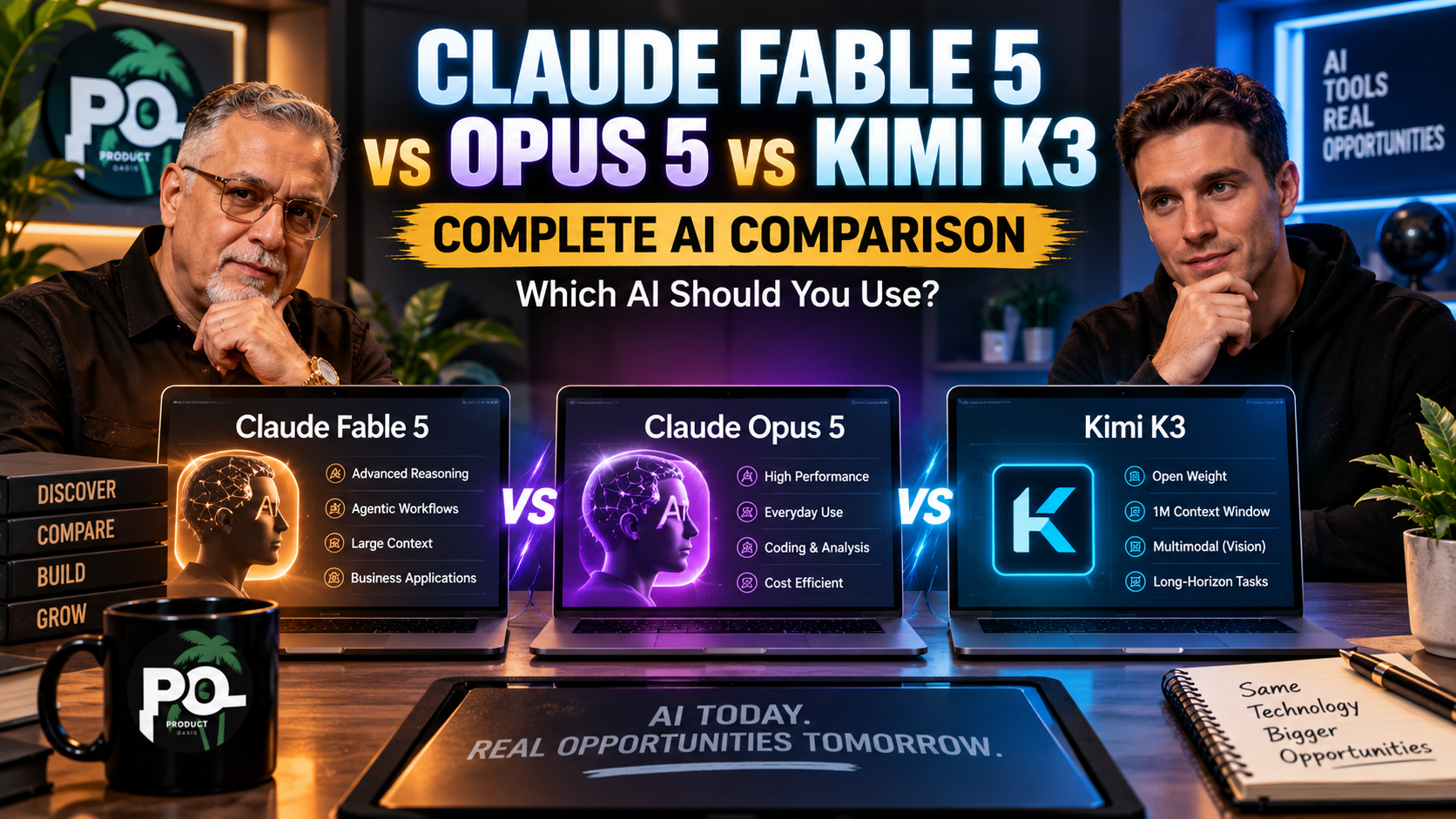
Comparing Claude Fable 5, Claude Opus 5, and Kimi K3 sounds like a simple model-versus-model question. In reality, these systems are aimed at somewhat different jobs — and the better choice depends on whether your priority is maximum reasoning depth, everyday AI work, open-weight flexibility, or turning AI capability into a practical business workflow.
For the business-focused reader, there is an even more important question: which option gives you the clearest path from powerful AI capability to something you can actually package, sell, and deliver? That is where Fable Fox AI enters the picture.
Claude Fable 5 vs Opus 5 vs Kimi K3: The Short Answer
Claude Opus 5 is the practical everyday choice in this comparison. Anthropic positions it as a highly capable general-purpose model with particular strength in software engineering and knowledge work, and its current API pricing is $5 per million input tokens and $25 per million output tokens. :contentReference[oaicite:0]{index=0}
Claude Fable 5 sits higher in Anthropic’s model family for demanding reasoning and long-horizon agentic work. Anthropic’s current documentation lists Claude Fable 5 with a 1-million-token context window and up to 128K output tokens; its successor, Claude Fable 5.1, is specifically positioned for demanding reasoning, long-running agentic coding, multistep research, and document, spreadsheet, and slide work. :contentReference[oaicite:1]{index=1}
Kimi K3 takes a different route. Moonshot describes it as a 2.8-trillion-parameter model with native vision and a 1-million-token context window, designed for long-horizon coding, knowledge work, reasoning, and agentic tasks. It is particularly interesting if open-model access and multimodal capability are important to you. :contentReference[oaicite:2]{index=2}
But if your goal is not simply to chat with an AI, but to turn advanced AI capability into a business-asset workflow, Fable Fox AI deserves a separate look. Its supplied product material presents a workshop built around using Claude Fable 5 to help freelancers, agencies, solopreneurs, creators, and beginners create business assets from a single business link. :contentReference[oaicite:3]{index=3}
Quick Comparison: Fable 5 vs Opus 5 vs Kimi K3
| Category | Claude Fable 5 | Claude Opus 5 | Kimi K3 |
|---|---|---|---|
| Primary positioning | Demanding reasoning and long-horizon agentic work | General-purpose high-end AI and knowledge work | Open-weight frontier model with strong agentic and multimodal capabilities |
| Context window | 1M tokens | 1M tokens | 1M tokens |
| Maximum output | 128K tokens | 128K tokens | Model/platform dependent |
| Vision | Text and image input | Text and image input | Native vision |
| Long-horizon work | Excellent fit | Strong fit | Strong fit |
| Open-weight model | No | No | Yes |
| API pricing | Higher-cost tier | $5 input / $25 output per million tokens | Kimi lists $3 input / $15 output per million tokens for cache-miss API usage |
Anthropic currently lists both Fable 5.1 and Opus 5 at a 1-million-token context window and 128K maximum output. Fable 5.1 is priced at $10/$50 per million input/output tokens, while Opus 5 is $5/$25. Kimi’s official K3 page lists 1M context, native vision, and API pricing of $3 per million cache-miss input tokens and $15 per million output tokens. :contentReference[oaicite:4]{index=4}
What Is Claude Fable 5?
Claude Fable 5 is part of Anthropic’s high-end Claude model family, designed for tasks where the AI needs to reason through complicated problems and maintain context across long-running workflows.
Anthropic’s migration documentation describes Fable 5 as being built for demanding reasoning and long-horizon agentic work. It uses adaptive thinking, has a 1-million-token context window, and can produce up to 128K output tokens per request. :contentReference[oaicite:5]{index=5}
The important distinction is that Fable 5 is not simply positioned as a faster chatbot. It is aimed at workflows where the AI may need to reason, use tools, maintain substantial context, and continue working through multiple stages.
What Is Claude Opus 5?
Claude Opus 5 is the more practical high-end Claude option for everyday professional use. Anthropic describes it as a thoughtful and proactive model and specifically highlights software engineering, coding, knowledge work, and everyday use. :contentReference[oaicite:6]{index=6}
One of the biggest differences is economics. Anthropic lists Opus 5 at $5 per million input tokens and $25 per million output tokens, compared with $10/$50 for Claude Fable 5.1. :contentReference[oaicite:7]{index=7}
That makes Opus 5 particularly interesting for people who want substantial reasoning capability without automatically moving to the more expensive Fable tier.
What Is Kimi K3?
Kimi K3 is Moonshot AI’s high-end model with a very different strategic profile.
The official Kimi documentation describes K3 as a 2.8-trillion-parameter model with native vision and a 1-million-token context window. It is designed for long-horizon coding, knowledge work, reasoning, and agentic execution. :contentReference[oaicite:8]{index=8}
Kimi also emphasizes the model’s open-weight direction. That makes K3 particularly relevant to developers and organizations that care about model access, deployment flexibility, experimentation, and multimodal workflows rather than simply choosing a hosted proprietary chatbot.
Claude Fable 5 vs Opus 5
This is the most important comparison if you are already inside the Claude ecosystem.
Reasoning and Complex Work
Fable 5 is positioned for the harder end of the workload spectrum. Anthropic specifically describes Fable 5 and its 5.1 successor around demanding reasoning and long-horizon agentic work. :contentReference[oaicite:9]{index=9}
Opus 5 remains extremely capable, but Anthropic positions it as the model to start with for most workloads, moving to Fable 5.1 when higher-effort Opus performance is insufficient for a demanding task. :contentReference[oaicite:10]{index=10}
Cost
Opus 5 has a significant price advantage at the API level. The currently published figures are $5/$25 per million input/output tokens for Opus 5 versus $10/$50 for Fable 5.1. :contentReference[oaicite:11]{index=11}
Long-Context Work
Both models support a 1-million-token context window. This means the comparison is less about whether they can handle long context and more about which reasoning profile is appropriate for the task. :contentReference[oaicite:12]{index=12}
Simple takeaway: Choose Opus 5 when you want high-end Claude capability as an everyday workhorse. Consider Fable 5 when the task justifies deeper reasoning and long-horizon agentic work.
Claude Fable 5 vs Kimi K3
This comparison is more interesting because the models represent different approaches.
Proprietary vs Open-Weight
Claude Fable 5 is part of Anthropic’s proprietary model ecosystem. Kimi K3 is positioned as an open model, with Moonshot highlighting its 2.8T parameter scale, native vision, and availability across Kimi’s applications and API ecosystem. :contentReference[oaicite:13]{index=13}
If open-model flexibility is one of your primary requirements, Kimi K3 has a major strategic advantage in this particular comparison.
Agentic Work
Both are designed for substantial multi-step work. Anthropic positions Fable 5 around demanding reasoning and long-horizon agents, while Kimi highlights long-horizon coding, knowledge work, tool use, and autonomous execution. :contentReference[oaicite:14]{index=14}
Multimodal Capability
Kimi K3 has native vision as a core part of its model design. Kimi describes K3 as capable of working with text, images, and video, which gives it a particularly interesting role in visual and interactive workflows. :contentReference[oaicite:15]{index=15}
Opus 5 vs Kimi K3
For an everyday user, this can come down to ecosystem preference.
Opus 5 is positioned by Anthropic as an everyday high-end model, with strong performance in software engineering and knowledge work and a clearly published API cost structure. :contentReference[oaicite:16]{index=16}
Kimi K3 is more compelling when you specifically value its open-model positioning, native vision, long context, and agentic capabilities. Kimi currently describes K3 as its most capable model and makes it available through Kimi, Kimi Work, Kimi Code, and the Kimi API. :contentReference[oaicite:17]{index=17}
So this is not simply a question of “which model has the biggest number?” It is a question of which model fits the workflow you actually want to run.
Where Does Fable Fox AI Fit Into This?
This is where the comparison changes from AI model shopping to AI business execution.
Fable Fox AI is presented as a workshop designed around using Claude Fable 5 for business-asset creation. The supplied material specifically describes a workflow in which a business can be studied from a single link and AI-generated assets can then be packaged into deliverables for businesses. :contentReference[oaicite:18]{index=18}
The product material specifically targets freelancers, agency owners, solopreneurs, content creators, and beginners. It also describes a model in which users can use the generated assets as client deliverables rather than merely consuming AI output for personal use. :contentReference[oaicite:19]{index=19}
That distinction matters.
You can spend hours comparing AI benchmarks, switching between models, testing prompts, and deciding which interface you prefer.
Or you can ask a more commercially useful question:
How can I turn the capabilities of today’s strongest AI models into something a real business will pay for?
That is the problem Fable Fox AI is specifically designed to address.
Explore the Fable Fox AI Workshop
How Fable Fox AI Works
Based on the supplied product material, the basic concept is straightforward:
- Start with a business. The offer describes using a business link as the starting point.
- Let the AI analyze the business. The product material describes an AI-agent workflow built around understanding what the business needs.
- Generate business assets. The material claims that users can produce 300+ ready-to-sell business assets in minutes.
- Package the output. The intended commercial use is to turn those assets into client deliverables.
- Offer the service to businesses. The supplied material gives $97/month as an example of how the assets could be packaged for a business. That is a marketing example from the supplied material, not a guaranteed income result. :contentReference[oaicite:20]{index=20}
The attraction is not that Fable Fox AI magically creates a business for you. The attraction is the attempt to turn advanced AI capability into a repeatable service-delivery workflow.
What Can You Actually Do With These AI Models?
The three models can overlap heavily, but their strongest positioning differs.
| Use Case | Model to Consider | Why |
|---|---|---|
| Everyday professional AI | Opus 5 | Strong general-purpose capability with lower published API pricing than Fable 5.1 |
| Demanding reasoning | Fable 5 / Fable 5.1 | Anthropic explicitly positions the Fable line for demanding reasoning and long-horizon agentic work |
| Long-horizon coding | Fable 5.1 / Kimi K3 | Both vendors emphasize long-running agentic coding capability |
| Native visual workflows | Kimi K3 | Native vision is a core K3 capability |
| Open-model experimentation | Kimi K3 | Open-weight positioning gives developers more flexibility |
| Business-asset monetization workflow | Fable Fox AI | Specifically packaged around turning Claude Fable 5 capability into business deliverables |
Fable Fox AI vs Using Claude Directly
This is an important distinction.
If you simply want to ask Claude questions, write content, analyze documents, or code, you may not need a separate business-focused workshop.
But if your goal is to build a service around AI-generated business assets, the challenge changes. You need to know what to ask the AI to create, how to structure the workflow, how to turn the output into deliverables, and how to position those deliverables for businesses.
That is the gap Fable Fox AI is attempting to fill.
In other words, Claude is the underlying AI capability; Fable Fox AI is positioned as the business-use framework around that capability.
Fable Fox AI Pricing
The exact current checkout price for Fable Fox AI could not be independently verified from the accessible checkout page at the time of writing.
A current September 2026 JV launch listing categorizes Fable Fox AI in the low-ticket $1–$197 range, but that listing does not establish the exact front-end price, order bumps, or upgrade prices. :contentReference[oaicite:21]{index=21}
For that reason, the safest approach is to check the current offer page for the actual price before purchasing.
Check Current Fable Fox AI Access
Fable Fox AI OTOs and Upgrades
[NEEDS VERIFICATION] The accessible product information does not provide enough reliable detail to list current OTO names, prices, upgrade contents, or bundle structures without risking inaccurate information.
Those details should therefore be checked on the live checkout or offer page rather than guessed from launch material.
Fable Fox AI Bonuses
[NEEDS VERIFICATION] No independently verified bonus stack was available in the supplied material used for this article.
That means this article intentionally does not invent a bonus list. If bonuses are displayed on the current offer page, evaluate them according to whether they directly help you implement the business-asset workflow.
Who Is Fable Fox AI For?
- Freelancers who want to increase the amount of work they can deliver.
- Agency owners looking for AI-assisted deliverables without immediately expanding their team.
- Solopreneurs who want a more structured way to use advanced AI.
- Content creators who need a repeatable production workflow.
- Beginners who want a guided business-oriented introduction to using advanced AI.
These audiences are directly reflected in the supplied Fable Fox AI material. :contentReference[oaicite:22]{index=22}
Who May Not Need Fable Fox AI?
If you are already an experienced Claude user and have your own proven system for analyzing businesses, creating deliverables, packaging services, and selling those services, you may not need an additional framework.
Likewise, if you only want an AI assistant for casual questions or personal productivity, a direct Claude or Kimi subscription may be sufficient.
The strongest case for Fable Fox AI is therefore not “everyone needs another AI tool.” It is the person who wants to move from using AI to using AI as part of a sellable service workflow.
Fable Fox AI Pros and Cons
| Potential Advantages | Important Limitations |
|---|---|
| Business-focused rather than purely chatbot-focused | Exact current pricing requires checking the live offer |
| Built around Claude Fable 5 capability | Results depend on how effectively the user implements the workflow |
| Designed for freelancers, agencies and solopreneurs | Not necessary for users who already have a comparable system |
| Focuses on reusable business assets | Current OTO and bonus details require verification |
| Potentially reduces the need to build every asset from scratch | AI output still needs human review and quality control |
Claude Fable 5 vs Opus 5 vs Kimi K3: Which Should You Use?
Choose Claude Opus 5 If…
You want a powerful general-purpose Claude model for regular professional work and care about keeping API costs below the Fable tier. Anthropic itself recommends starting with Opus 5 for most workloads and moving to Fable 5.1 when more demanding reasoning or long-horizon agentic capability is required. :contentReference[oaicite:23]{index=23}
Choose Claude Fable 5 If…
Your work demands deeper reasoning, large context, long-running agentic execution, or complex multi-step workflows. Fable 5 is explicitly designed around those requirements. :contentReference[oaicite:24]{index=24}
Choose Kimi K3 If…
You place a high value on open-model access, native vision, long context, and agentic workflows. Kimi K3 is a particularly distinctive option because of its 2.8T parameter scale and open-weight positioning. :contentReference[oaicite:25]{index=25}
Consider Fable Fox AI If…
Your real objective is not simply selecting an AI model. You want a structured way to explore how Claude Fable 5 can be turned into business assets and client-facing services.
That is the key reason Fable Fox AI stands apart from simply comparing chatbot subscriptions.
Is Fable Fox AI Legit?
There is a real product launch associated with the name Fable Fox AI. A current September 2026 JV launch calendar identifies Firas Alameh as the vendor and lists the launch for September 18, 2026 through JVZoo. The listing describes the offer as a business-asset platform built around Claude Fable 5. :contentReference[oaicite:26]{index=26}
The supplied product material also clearly describes the intended audience and the proposed workflow around analyzing a business and generating sellable assets. :contentReference[oaicite:27]{index=27}
What cannot be independently confirmed from the available material is the complete current pricing structure, all upgrades, all bonuses, and any specific guarantee terms. Those should be checked before purchase.
What About the $97/Month Business Model?
The supplied Fable Fox AI material gives $97/month as an example of how a user could package AI-generated assets as a recurring business service. :contentReference[oaicite:28]{index=28}
That should be understood as an example of a potential offer structure, not as a guaranteed income level or a promise that businesses will automatically pay that amount.
The actual commercial opportunity depends on factors such as the quality of the deliverables, the niche, the business’s needs, the user’s sales ability, pricing strategy, competition, and ongoing client service.
Frequently Asked Questions
Is Claude Fable 5 better than Opus 5?
They are positioned for different levels of work. Anthropic positions Fable 5 and Fable 5.1 for demanding reasoning and long-horizon agentic tasks, while Opus 5 is positioned as a strong everyday model and is recommended by Anthropic as the starting point for most workloads. :contentReference[oaicite:29]{index=29}
Is Kimi K3 better than Claude Fable 5?
There is no single answer for every workload. Kimi K3 emphasizes open-model access, native vision, long context, coding, reasoning, and agentic execution, while Claude Fable 5 is positioned around demanding reasoning and long-horizon agentic work. :contentReference[oaicite:30]{index=30}
Does Kimi K3 have a 1 million token context window?
Yes. Kimi’s official documentation lists a 1-million-token context window for K3. :contentReference[oaicite:31]{index=31}
How much does Claude Opus 5 cost?
Anthropic currently lists Claude Opus 5 at $5 per million input tokens and $25 per million output tokens through its API. :contentReference[oaicite:32]{index=32}
How much does Claude Fable 5 cost?
Anthropic’s current documentation lists Claude Fable 5.1 at $10 per million input tokens and $50 per million output tokens. :contentReference[oaicite:33]{index=33}
Is Fable Fox AI the same thing as Claude Fable 5?
No. Claude Fable 5 is an Anthropic AI model. Fable Fox AI is a separate business-focused offer built around using Claude Fable 5 capabilities. The supplied Fable Fox material presents it as a workshop and workflow for creating business assets with the model. :contentReference[oaicite:34]{index=34}
Can beginners use Fable Fox AI?
The supplied product material explicitly includes complete beginners among its intended users. :contentReference[oaicite:35]{index=35}
Does Fable Fox AI guarantee recurring income?
No guarantee should be assumed. The supplied material describes a potential business model and gives an example of packaging assets at $97/month, but that is not evidence of guaranteed income.
Should I choose an AI model or a business workflow?
If your goal is personal productivity, model selection is central. If your goal is building a service business around AI, the workflow can matter just as much as the underlying model. That is the problem Fable Fox AI is specifically positioned around.
Final Verdict: Claude Fable 5 vs Opus 5 vs Kimi K3
If you are choosing strictly between the three AI models, the decision is relatively clear:
- Opus 5 makes sense as the everyday high-end Claude workhorse.
- Fable 5 is aimed at more demanding reasoning and long-horizon agentic work.
- Kimi K3 stands out for open-model access, native vision, massive context, and long-horizon agentic capability.
But for the person reading this comparison with a business goal, there is another layer.
You do not necessarily need to become an AI-model expert to benefit from advanced AI. You need a practical way to turn the technology into useful outputs that solve problems for real businesses.
That is why Fable Fox AI is the most commercially relevant next step in this comparison for a freelancer, agency owner, solopreneur, content creator, or beginner who wants to explore a business-asset model around Claude Fable 5.
It is not a replacement for Claude, Opus, or Kimi. It is positioned as the layer that helps turn advanced model capability into a repeatable business workflow.
If that is the outcome you are looking for, the next step is to review the current Fable Fox AI offer and see whether the present version matches the workflow you want to build.
The bottom line: compare the models for capability, but compare the workflows for business value. If your objective is to move beyond simply using AI and start building sellable business assets with it, Fable Fox AI is the option in this comparison that is specifically built around that goal.