
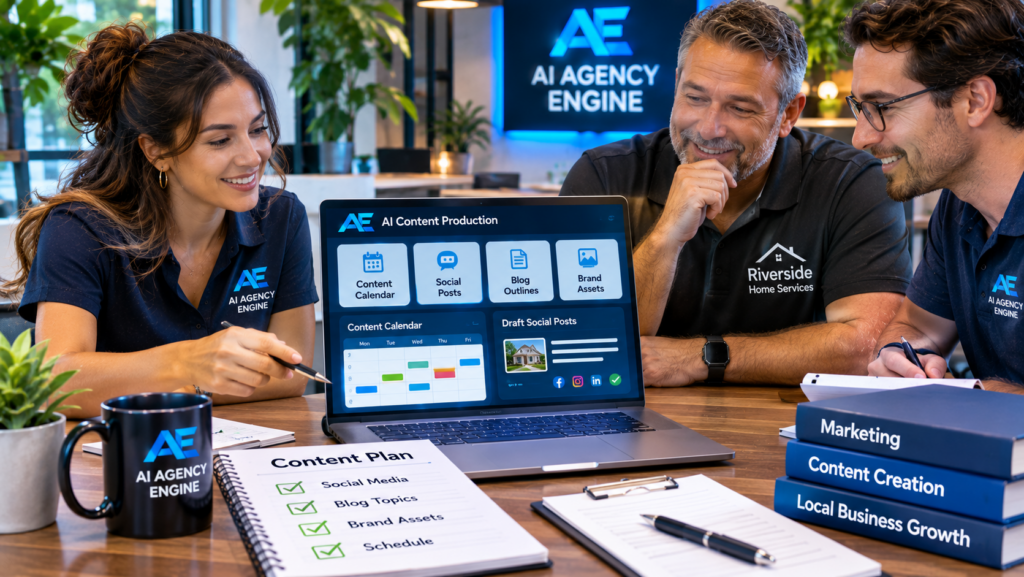
AI content automation for local businesses works best when you build a repeatable workflow that researches the business, plans relevant topics, creates content drafts, checks accuracy and prepares everything for publication. Instead of producing random AI-generated posts, you create a structured system that helps businesses maintain a consistent online presence while reducing repetitive content tasks. AI Agency Engine introduces AI teams and coordinated workflows that can support this approach, making its AI Agency Engine training and resources relevant to people exploring content automation as an agency service.
What Is AI Content Automation for Local Businesses?
AI content automation uses artificial intelligence to assist with planning, drafting, organizing and preparing marketing content. For a local business, this could include website articles, service-page content, social media posts, frequently asked questions, promotional emails and customer education material.
The objective is not to publish as much AI-generated content as possible. It is to create a reliable process that produces useful, accurate and locally relevant content without starting from scratch every time.
For an AI agency, this can become a recurring service. You can help a business plan its content, prepare drafts, maintain a publishing schedule and review performance through an agreed monthly workflow.
Why Local Businesses Need a Repeatable Content Workflow
Many local businesses understand that online visibility matters but struggle to publish consistently. Owners and employees are often busy managing customers, appointments and daily operations.
A repeatable AI content workflow can help organize the process. Rather than expecting the business owner to think of new topics, write every article and prepare every social post, you establish a system with clear stages and responsibilities.
Consistency still needs to be balanced with quality. Content should answer real customer questions, accurately describe the business and provide information that is useful to people in its service area.
How to Build an AI Content Automation Workflow in Five Steps
1. Research the Business and Its Audience
Start by understanding what the business offers, who its customers are and which locations it serves. Review its services, common customer questions, seasonal activities and the information potential customers need before making a purchase or booking.
For example, a plumbing company might need content about common plumbing problems, service availability and maintenance questions. A dental practice might need educational content about treatments, appointments and general oral care information.
Research should guide the content plan. Do not invent services, prices, credentials or business claims simply to fill a publishing calendar.
2. Create a Monthly Content Plan
Turn your research into a manageable publishing schedule. Choose a small number of useful topics and decide which format best answers each customer question.
A monthly plan might include:
- Two educational website articles addressing common customer questions.
- Four short social media posts highlighting services or useful information.
- One frequently asked questions update based on customer enquiries.
- One promotional email or seasonal announcement, when appropriate.
The actual volume should depend on the client’s budget, audience and ability to review and approve content.
3. Use AI to Create First Drafts
Once the topics are approved, use AI assistants to prepare initial drafts. Give each task clear instructions covering the audience, purpose, tone, location and information that must be included.
For a local service article, provide the correct service details and explain the intended customer question. Ask the AI to organize the information with descriptive headings, short paragraphs and practical explanations.
AI-generated content should always be reviewed. Check facts, remove generic statements, correct inaccurate details and add genuine business knowledge before publication.
4. Repurpose and Prepare Content for Different Channels
A useful article can provide the foundation for several related content assets. For example, one educational article could be adapted into short social posts, an email summary and a list of frequently asked questions.
Repurposing helps create a consistent message across channels without treating every format as a completely separate writing project. However, each version should be adapted to its audience and platform rather than copied mechanically.
5. Review, Approve and Schedule Publication
Establish a clear approval process before content goes live. The business should confirm that service information, claims, contact details and promotional statements are accurate.
Once approved, prepare the content for the relevant publishing channels and record its publication date. Review performance periodically to identify which topics attract useful engagement and which questions deserve more attention.
How AI Teams Can Support Content Automation
AI teams can help divide the content process into separate responsibilities. One assistant might support research, another could prepare article drafts, while another helps organize summaries or repurposed content.
AI Agency Engine introduces Murage, a desktop application built around a Chief of Staff that coordinates specialist AI bots. Its ready-made AI team library is intended to help participants import and adapt existing teams instead of building every assistant from scratch.
This structure can provide a framework for organizing repeatable content tasks. The user still needs to define each assistant’s role, provide accurate business information and review the final material. Murage is offered as a free application, although connected AI providers and services may involve separate costs.
How to Offer Content Automation as a Monthly Agency Service
Package the workflow around clearly defined deliverables. For example, you might offer a monthly content plan, a set number of approved articles, social media drafts and a short activity report.
Agree on the number of revisions, approval responsibilities, publishing arrangements and any additional services before work begins. This makes expectations clearer for both parties and gives the client a consistent service rather than an undefined promise of unlimited content.
For a closer look at how Murage, AI teams and the wider agency workflow fit together, read the complete AI Agency Engine review.
Common AI Content Automation Mistakes to Avoid
- Publishing without fact-checking: Verify every business detail and factual claim.
- Creating generic content: Include genuine local context and answer specific customer questions.
- Producing too much content: Prioritize useful material over publishing volume.
- Ignoring client approval: Establish who checks and approves content before publication.
- Measuring only output: Review whether content serves customer needs and supports the business’s objectives.
Frequently Asked Questions
Can AI automate content creation for local businesses?
Yes. AI can assist with topic planning, research organization, drafting, repurposing and content preparation. Human review is still necessary to ensure accuracy and relevance.
What content can a local business automate?
Possible formats include website articles, service-page drafts, social media posts, FAQs, educational emails and promotional content.
Can an AI agency charge monthly for content automation?
Yes. An agency can offer recurring content planning, drafting, editing and reporting services under a clearly defined monthly agreement.
Does AI-generated content need human editing?
Yes. Review content for factual accuracy, originality, local relevance, brand consistency and usefulness before publication.
Final Thoughts
AI content automation gives local businesses a practical way to organize consistent marketing without making every piece of content a new project. The strongest workflow combines business research, planned topics, AI-assisted drafting, human editing, client approval and regular performance reviews.
For an AI agency, this can become a repeatable service with clearly defined monthly deliverables. AI Agency Engine introduces Murage, ready-made AI teams and training resources that can help users explore this type of AI-assisted business workflow. To see how the tools, training, features and offer fit together, visit the full AI Agency Engine review and offer breakdown.