
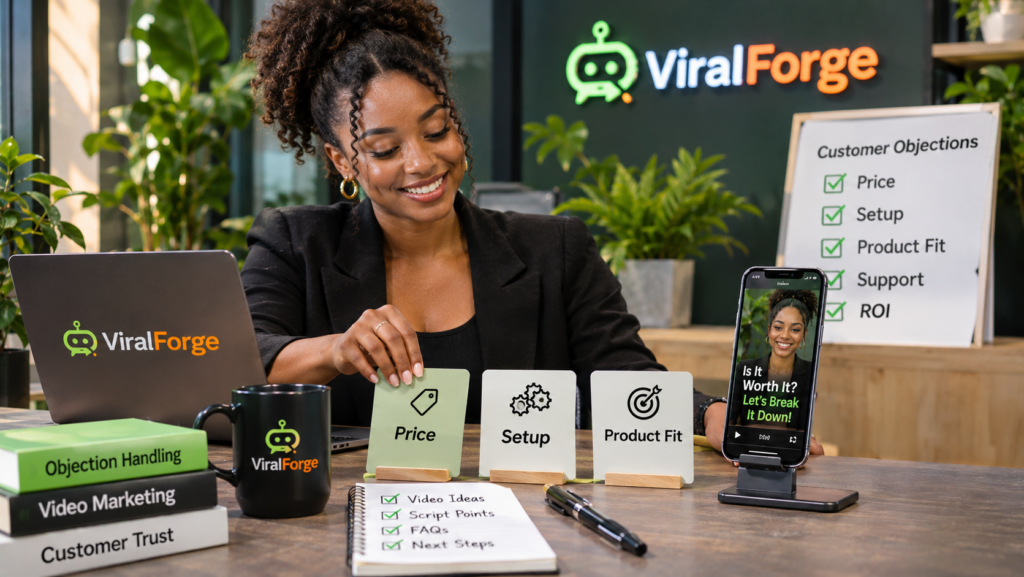
To answer customer buying objections with short videos using ViralForge, identify the questions or concerns that prevent potential customers from purchasing, then create one focused video that addresses each objection with a clear, honest explanation. Common concerns include price, product suitability, ease of use, reliability, and the time required to get started. An AI-assisted platform such as ViralForge for creating customer-focused short videos can help you develop scripts, adapt creative angles, and produce variations that explain your offer more effectively.
Why Use Short Videos to Address Customer Buying Objections?
Customers rarely make purchasing decisions based on product features alone. They also consider whether a product fits their needs, whether the price is justified, how difficult it will be to use, and whether they can trust the business behind it.
These concerns are known as buying objections. If they remain unanswered, potential customers may delay a decision or choose another option.
Short videos provide a direct way to address these questions. A concise explanation, product demonstration, comparison, or practical example can help viewers understand what they are buying and decide whether it is suitable for them.
For example, a software business could create a video showing how a beginner completes a common task. An online retailer could demonstrate product dimensions and practical use. A service provider could explain what is included in a package and what customers should expect.
Which Customer Buying Objections Should Your Videos Address?
Start by collecting questions from sales conversations, customer messages, product reviews, and support requests. Look for concerns that appear repeatedly.
- Price objections: Explain what the price includes and which features or services customers receive.
- Product suitability: Clarify who the product is designed for and who may need a different solution.
- Ease-of-use concerns: Demonstrate the setup process or show how a common task is completed.
- Trust and reliability: Provide verifiable product information, accurate demonstrations, and transparent terms.
- Time concerns: Explain the actual steps involved in getting started or using the product.
- Comparison questions: Describe meaningful differences between your offer and alternative solutions without making unsupported claims.
Do not assume every customer has the same concern. Prioritize objections that are relevant to your audience and important to the buying decision.
How to Create Objection-Handling Videos With ViralForge
A simple, repeatable workflow helps turn customer questions into useful short-form videos.
- List your most common objections. Review customer conversations and identify the questions that frequently arise before a purchase.
- Choose one objection per video. Avoid trying to answer every concern in one clip. Give each video a specific purpose.
- Write a direct opening hook. Start with the concern itself. For example: “Wondering whether this software is difficult for beginners?”
- Provide a clear explanation. Answer the question using accurate details, practical examples, or a product demonstration.
- Show supporting evidence. Use real product footage, screenshots, demonstrations, or clearly explained terms where appropriate.
- Finish with a relevant next step. Invite viewers to explore the product, review the details, or contact your business with further questions.
Keep the tone helpful rather than defensive. The purpose is to help customers make informed decisions, not to pressure them into buying.
How ViralForge Can Help Create Customer Objection Videos
ViralForge describes an AI-assisted content workflow that may support the development and production of objection-handling videos. Its features include TrendRadar for discovering content concepts, DNA Decoder for analyzing creative structures, and SwapEngine for adapting content.
For example, a business could create a video addressing the objection that a product is too complicated to use. The script might begin with a question, demonstrate a basic task, and explain what a new customer needs to get started.
SwapEngine is designed to adapt creative elements such as scripts, presenters, voices, languages, and calls to action. FreshHooks and the variation workflow can help develop alternative openings, captions, hashtags, and on-screen text for the same customer concern.
AI presenters and voices may also help businesses produce explanatory videos without recording every segment themselves. The final content should still be reviewed to ensure that demonstrations, product claims, and answers accurately reflect the actual offer.
To explore the platform’s described features and workflow, read the ViralForge review and product overview at Product Oasis.
Examples of Short Videos That Address Buying Objections
Different objections call for different video formats. Here are some practical examples:
- “Is it difficult to use?” Create a quick beginner demonstration showing the first steps.
- “Is it worth the price?” Explain what is included and demonstrate the features or services customers receive.
- “Will it work for my business?” Describe the intended audience and show a relevant use case.
- “How long does setup take?” Walk through the actual setup process without promising a time that cannot be guaranteed.
- “How is it different from alternatives?” Compare relevant features and limitations using accurate information.
These videos can become part of a wider content library that your business uses across product pages, social media campaigns, and customer education activities.
Tips for Making Objection-Handling Videos More Effective
- Use the customer’s language: Phrase the opening around the questions people actually ask.
- Answer directly: Address the concern early instead of hiding the answer behind a long introduction.
- Be transparent: Explain limitations, requirements, and conditions where relevant.
- Use demonstrations: Show how a product works whenever visuals can make the answer clearer.
- Avoid exaggerated promises: Do not guarantee results, savings, or outcomes without reliable evidence.
- Keep videos focused: One objection and one clear answer make each clip easier to understand.
Frequently Asked Questions
What is an objection-handling video?
An objection-handling video addresses a concern that may prevent someone from purchasing. It could explain pricing, demonstrate ease of use, clarify product suitability, or answer a common question.
How long should a customer objection video be?
Use enough time to answer the question clearly without unnecessary information. A simple concern may need only a brief explanation, while a product demonstration may require more time.
Can AI create videos that answer customer questions?
AI-assisted tools can help develop scripts, narration, presenters, captions, and creative variations. Businesses should review every answer to ensure it is accurate and consistent with their actual product or service.
How many objection-handling videos should a business create?
Start with the most frequent and important customer concerns. Create a separate video for each major objection, then expand the collection as new questions arise.
Final Thoughts
Short videos can help answer customer buying objections by making important product information easier to understand. Identify real customer concerns, address one question at a time, and use clear explanations or demonstrations to help viewers evaluate your offer.
ViralForge may support this process through its described content discovery, script adaptation, AI presenter, voice, and creative variation features. Use AI to make production more manageable while keeping honesty, accuracy, and customer needs at the center of every video.
To decide whether the platform suits your content workflow, explore the complete ViralForge review at Product Oasis.