
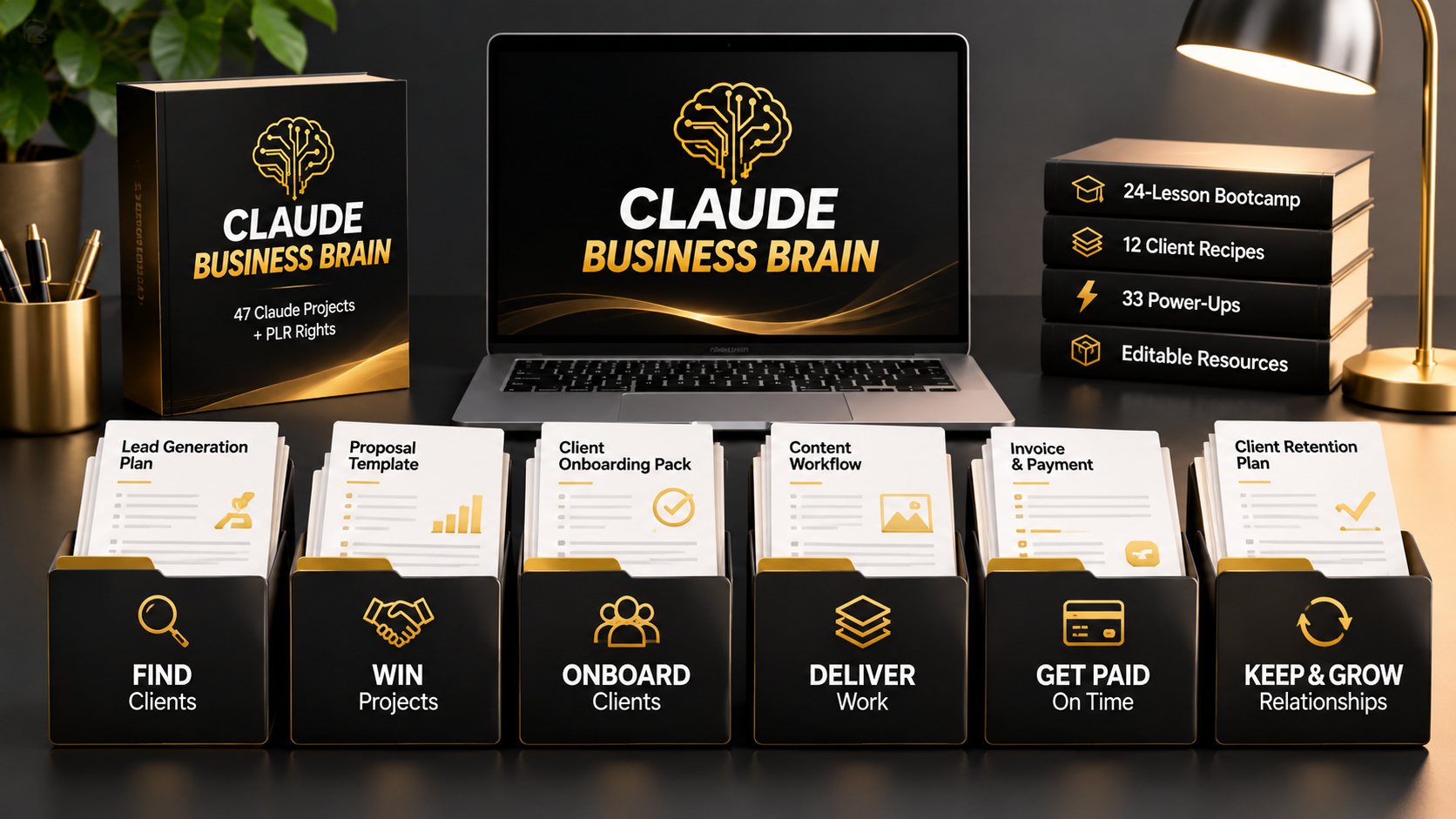
Claude Business Brain includes 47 ready-made Claude Projects organised into six stages of the client journey—from finding prospects and winning new business to onboarding clients, delivering work, getting paid, and growing long-term relationships. Each Project is designed as a specialist workspace with a defined role, step-by-step method, output format, quality rules, and guidance on which files to add. Instead of repeatedly starting with a blank chat, you can use a prepared workflow for a specific business task. Explore Claude Business Brain and its 47 Projects here.
What Are the 47 Claude Business Brain Projects?
The 47 Projects are grouped into six practical stages called the Client Loop. Together, they cover recurring activities that freelancers, consultants, agencies, and other service businesses handle when attracting clients and completing paid work.
Stage 1: Find Clients — 8 Projects
The first stage focuses on identifying potential customers and understanding the market before spending time on outreach. Its eight Projects help users explore their ideal clients, research competitors, assess demand, investigate prospects, and consider pricing.
Named examples include:
- Ideal Client Finder: Helps clarify the type of customer a business should target.
- Competitor Teardown: Organises competitor research to help identify positioning and market opportunities.
- Demand Checker: Helps assess whether there is demand for a proposed service or offer.
- Lead List Builder: Creates a structured prospecting process, including search phrases, lead scoring, and reasons to contact potential customers.
- Prospect Deep-Dive: Supports closer research into individual prospects.
- Industry Briefing: Helps gather and organise industry context.
- Pricing Scout: Supports research into pricing considerations.
The eighth Project is identified as Positioning & Profile Builder. Together, these tools are intended to make prospect research more organised and targeted.
Stage 2: Win Them — 9 Projects
Once you have potential clients to approach, the second stage focuses on communication and converting interest into business. It includes outreach, sales-call preparation, proposals, and follow-up workflows.
Named Projects include Cold Email Sequence, LinkedIn Outreach, Discovery Call Prep, Proposal Writer, Objection Handler, Follow-Up Writer, and Service Page Builder. The stage also includes Package & Quote Builder.
One useful example is Proposal Writer. You can provide notes from a sales conversation and use the Project to organise the client’s stated requirements, deliverables, exclusions, timeline, price, and next steps. It also separates client statements from assumptions that should be checked before sending the proposal.
Stage 3: Onboard Them — 6 Projects
Winning a client is only the beginning. Stage three is designed to make the transition from a successful sale to active work more structured. Its named Projects include Client Onboarding Pack, Kickoff Brief, Scope Guard, and Brand Voice Guide.
These workflows address practical onboarding needs: collecting information, clarifying expectations, documenting the project brief, maintaining boundaries around the agreed scope, and capturing the client’s preferred communication style. The stage contains six Projects in total.
Stage 4: Deliver the Work — 12 Projects
This is the largest stage, covering the recurring work that service providers create for clients. Named examples include Social Content Month, Blog Post Engine, Newsletter Builder, SOP Writer, and Weekly Status Report.
For example, Social Content Month is designed to turn a client’s content requirements into a dated calendar with content pillars and prepared posts. Its example workflow also covers carousel slide content, Reel shot lists, story ideas, and comment-reply templates.
The broader delivery stage covers client content, documented processes, reporting, and other ongoing service tasks. Its purpose is to help users follow repeatable workflows while keeping the client’s voice and requirements in view.
Stage 5: Get Paid — 6 Projects
Stage five focuses on the financial administration that follows client delivery. Named Projects include Invoice Chaser, Cash-Flow Forecaster, Expense Sorter, and Price Rise Planner.
The Cash-Flow Forecaster is a particularly practical example. It is designed to use a business’s balance, expected client payments, and bills to create a 13-week forecast. It can show expected, cautious, and positive scenarios, flag potential shortfalls against a cash buffer, and present calculations alongside possible actions.
Stage 6: Keep and Grow — 6 Projects
The final stage helps turn completed client work into opportunities for future business. Named Projects include Case Study Writer, Referral Kit, Retainer Builder, and Quarterly Plan.
These workflows support activities such as documenting client outcomes, encouraging referrals, developing ongoing service arrangements, and planning the next quarter. The aim is to help businesses build on existing client relationships rather than treating every project as a one-time transaction.
What Does Each Project Actually Include?
Claude Business Brain is presented as more than a collection of short prompts. Each of its 47 Projects has a dedicated page containing:
- When and why to use the Project.
- The files or business information to add.
- Copy-and-paste setup instructions.
- A suggested first message.
- An example output.
- Follow-up guidance and a practical tip.
The bundle also includes a Business Profile and Client Card intended to provide reusable business and client context. In addition to the Projects, the package contains 12 Client Recipes, 33 Power-Ups, and a seven-day Quick Start. The Projects are supplied in PDF, editable Word, and copy-and-paste TXT formats. The instructions can also be adapted for other AI assistants, including ChatGPT and Gemini, although the available features depend on the AI service and plan being used.
Who Can Benefit from These 47 Projects?
Freelancers, consultants, agency owners, and service providers may find the workflows useful when they regularly handle prospecting, proposals, onboarding, content production, reporting, and invoicing. Digital product sellers may also be interested in the included private-label rights, which allow the material to be rebranded, edited, divided into smaller products, and resold under the licence terms. The rights are nonexclusive, and the original files should not be published on public websites or the licence itself transferred.
Are the 47 Claude Business Brain Projects Worth Exploring?
The main attraction is the range of business tasks covered by the six-stage Client Loop. Rather than relying on isolated prompts, users get structured specialist workflows with setup guidance and example outputs. You do not need to set up all 47 Projects at once; starting with one relevant task, such as building a lead list, writing a proposal, or following up on an invoice, is a practical way to evaluate the system.
For a closer look at the complete package, pricing, included resources, and licence details, read the Claude Business Brain review.
Bottom line: Claude Business Brain brings 47 business-focused Projects together in six stages: Find, Win, Onboard, Deliver, Get Paid, and Keep & Grow. Its value lies in giving users a prepared starting point for common client-work activities, with reusable instructions, context guidance, and examples rather than asking them to build every workflow from scratch.
For the full breakdown of Claude Business Brain and what is included, visit the complete Claude Business Brain review here.