
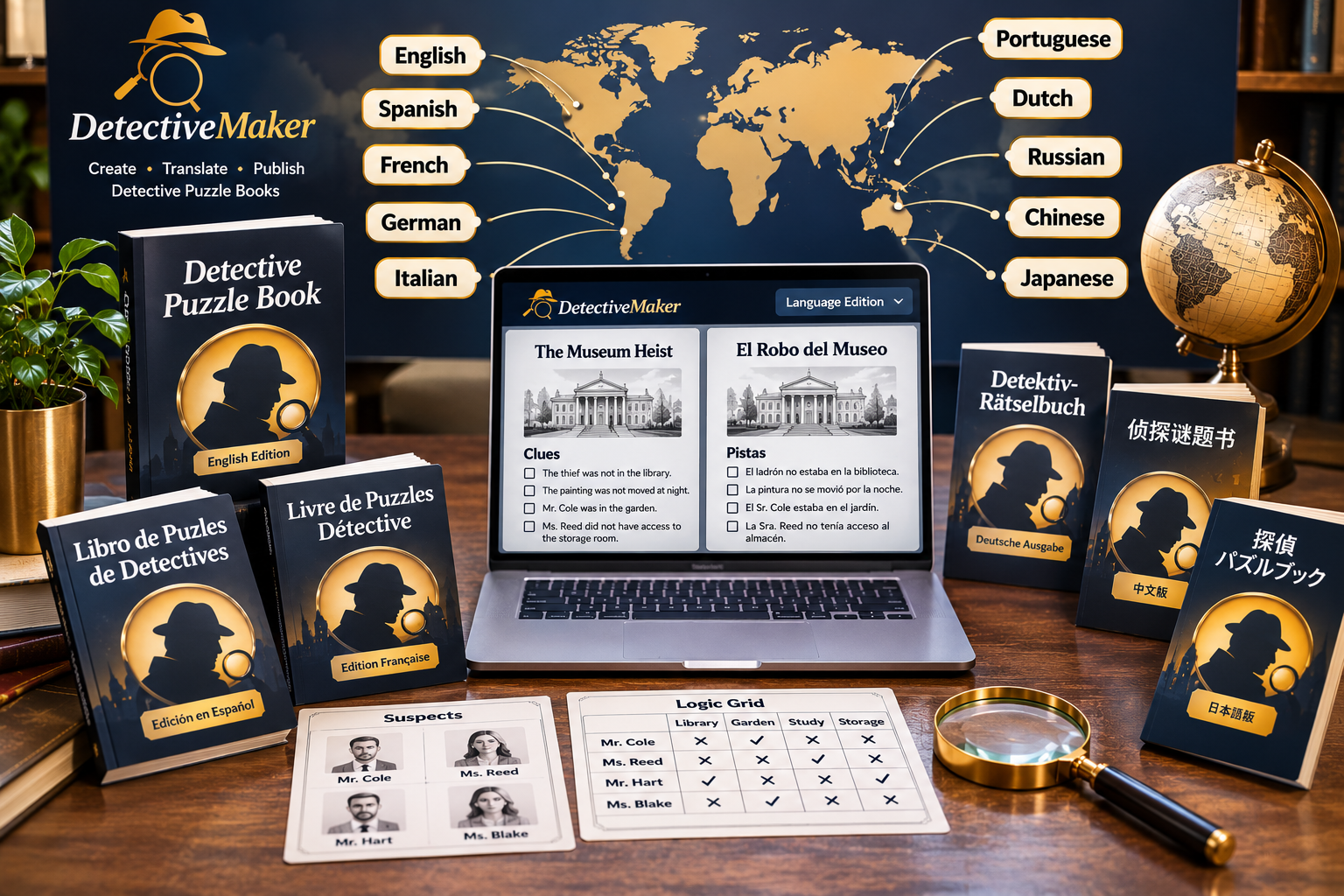
Yes, Detective Maker can help you create detective puzzle books in multiple languages, with support for 10 languages: English, French, German, Italian, Spanish, Portuguese, Japanese, Simplified Chinese, Korean, and Vietnamese. This makes the software useful for creators who want to develop detective puzzle products for audiences beyond English-speaking markets. You can use its AI-powered case generation and editing features to build mystery puzzles, then review and refine the content before publishing. Explore Detective Maker here.
Which Languages Does Detective Maker Support?
Detective Maker advertises support for the following 10 languages:
- English
- French
- German
- Italian
- Spanish
- Portuguese
- Japanese
- Simplified Chinese
- Korean
- Vietnamese
This language selection covers several major international markets and gives creators more flexibility when planning their puzzle book projects. Instead of limiting every product to English, you can explore creating localized detective mysteries for readers who prefer another supported language.
However, language support should not be confused with guaranteed professional translation. You should always check the generated wording, grammar, cultural references, and puzzle instructions before releasing a translated edition.
How Does Detective Maker Help Create Multilingual Puzzle Books?
Detective Maker is designed to generate detective-style deduction puzzles using AI. Its cases can include a mystery story, suspects, weapons, locations, clues, evidence, a deduction grid, and a solution.
These components provide the foundation for a complete puzzle. When creating content in a supported language, the same basic structure can be used to develop a collection for a different audience.
The visual editor also lets users modify generated content and work with the puzzle layout. This is important because a multilingual book needs more than translated story text. The clues, grid labels, instructions, headings, and solutions must all communicate clearly in the chosen language.
Step 1: Choose Your Target Language and Audience
Before generating puzzles, decide which language and audience you want to serve. For example, you might create a Spanish-language detective puzzle book for adult logic-puzzle enthusiasts or a French-language collection for readers who enjoy mystery activities.
Think about the audience’s familiarity with deduction puzzles, preferred difficulty, and cultural expectations. A clear target audience helps you choose appropriate vocabulary, themes, and presentation.
Step 2: Generate Your Detective Cases
Use Detective Maker to create the mystery content for your book. A generated case can include the story, suspects, possible weapons and locations, clues, evidence, deduction grid, and final solution.
Plan a consistent theme for each collection. For example, you could create a series of museum mysteries, country-house investigations, or detective cases set in a fictional town.
When developing multilingual editions, keep the underlying puzzle structure consistent where appropriate. This can make it easier to organize different language versions and compare their content during proofreading.
Step 3: Review the Language and Puzzle Logic
This is an essential stage of multilingual puzzle creation. Even if the software generates content in your selected language, you should not assume every sentence or clue is ready for publication.
Check the following elements carefully:
- Grammar and spelling: Correct awkward wording, spelling mistakes, and grammatical errors.
- Clue clarity: Make sure readers can understand exactly what each clue means.
- Consistent terminology: Use the same translated terms for suspects, locations, weapons, and other puzzle elements throughout the book.
- Grid accuracy: Confirm that labels and instructions match the mystery narrative.
- Solution consistency: Verify that the final answer agrees with all the clues and evidence.
If you are not fluent in the target language, consider having a native speaker review the content. This can help catch unnatural expressions and ambiguous wording that automated generation may miss.
Step 4: Customize the Layout for Each Language
After checking the content, use the visual editor to prepare the book pages. Detective Maker includes controls for book size, margins, page numbering, solution display, and adding pages. Its higher editions provide additional styling and layout customization options.
Remember that translated text may occupy more or less space than the original. Review every page to ensure headings, instructions, clues, and grids remain readable and properly aligned.
Some writing systems also require different font and character support. Check that the exported or prepared files display Japanese, Chinese, Korean, and other supported language characters correctly before publishing.
Step 5: Prepare and Publish Each Language Edition
Once the puzzles and layouts are complete, prepare the final files for your chosen publishing platform. You could organize separate editions by language, with clear titles and descriptions that tell customers exactly which language they are purchasing.
Review the finished files at their intended print size. Check page order, margins, instructions, grids, and answer sections. Make sure the product description accurately identifies the language and does not suggest that one edition includes translations that are not actually provided.
For a closer look at the software’s language options, features, pricing, and available editions, read the complete Detective Maker review.
Can Multilingual Detective Puzzle Books Reach More Buyers?
Creating books in multiple languages can give publishers opportunities to explore audiences in different markets. It may also help you test whether a particular puzzle theme appeals to readers outside your primary language market.
However, supporting 10 languages does not automatically guarantee international sales. Demand, competition, translation quality, product presentation, pricing, and marketplace visibility all influence commercial performance.
A sensible approach is to start with one additional language, carefully review the finished product, and evaluate its reception before investing in several more editions.
Final Verdict: Is Detective Maker Useful for Multilingual Puzzle Creation?
Detective Maker supports detective puzzle creation in 10 languages: English, French, German, Italian, Spanish, Portuguese, Japanese, Simplified Chinese, Korean, and Vietnamese. Its AI-generated mystery content and visual editing tools can help creators develop multilingual puzzle books without building every case and page entirely from scratch.
The most important consideration is quality control. Review translations, test every puzzle, verify the solutions, and make sure the final layout works correctly in each language. Used carefully, Detective Maker can be a practical starting point for creators who want to explore multilingual detective puzzle products.
To see the complete feature breakdown, pricing, editions, and bonuses before deciding whether the software fits your publishing plans, visit the full Detective Maker review.