One of the biggest frustrations for online creators today isn’t creating content.
It’s managing the endless stack of tools required to run a business.
You need:
- A course platform
- Funnel software
- Community tools
- AI writers
- Email systems
- Landing page builders
- Social schedulers
Before long, things become expensive, confusing, and difficult to manage.
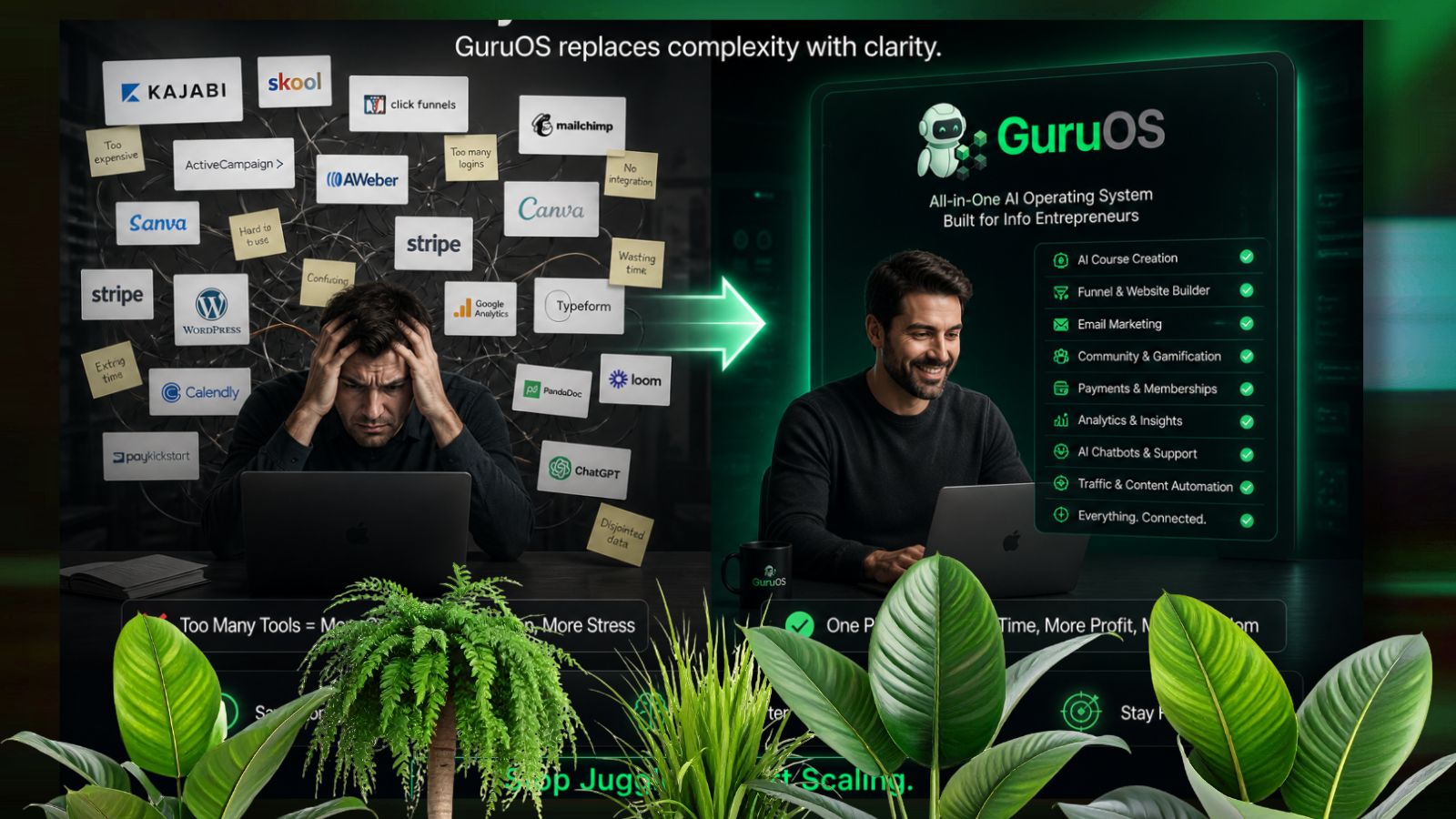
That’s exactly why many creators are now searching for a GuruOS all in one solution instead of piecing together disconnected software every month.
But can one platform really replace everything?
Let’s break down how GuruOS approaches the “too many tools” problem and whether it actually simplifies the process for info entrepreneurs in 2026.
Can GuruOS really replace multiple online business tools?
In simple terms, GuruOS is designed to combine course creation, AI automation, funnels, communities, traffic generation, and marketing into one connected platform. Instead of juggling separate tools for every task, users can manage their entire info business through coordinated AI agents inside a single operating system.
Why do info entrepreneurs struggle with too many tools?
Most online businesses evolve slowly.
At first, creators buy one tool.
Then another.
Then five more.
Eventually, they’re paying monthly fees for:
- Kajabi or Teachable
- ClickFunnels
- ConvertKit
- Canva
- ChatGPT
- Community platforms
- Automation software
The problem isn’t just cost.
What happens when your tools stop working together?
Disconnected tools create:
- Workflow confusion
- Branding inconsistency
- Technical headaches
- Lost productivity
However, the biggest issue is usually mental overload.
Creators spend more time managing systems than building products.
That’s the exact pain point GuruOS tries to solve.
How does the GuruOS all in one system actually work?
According to the JV documents and product materials, GuruOS operates like a coordinated AI business operating system rather than a standalone app.
Instead of isolated software features, the platform deploys specialized AI agents that work together.
These agents can handle:
- Course creation
- Funnel building
- Traffic generation
- Community engagement
- AI coaching
- Landing pages
- Marketing campaigns
The key idea is integration.
Everything runs inside the same ecosystem.
What tools can GuruOS potentially replace?
This is where the platform becomes interesting.
Can GuruOS replace course platforms?
Yes.
GuruOS includes:
- Video course hosting
- Drip-feed memberships
- Lesson management
- AI coaching agents
- eBook generation
Therefore, many users may no longer need separate platforms like Teachable or Kajabi.
Can GuruOS replace funnel builders?
According to the product information, GuruOS includes:
- Landing page builders
- AI sales copy generation
- Lead capture systems
- Payment integrations
- Funnel pages
As a result, creators can potentially avoid separate funnel software subscriptions.
Does GuruOS include community features too?
Yes—and this is one of the platform’s strongest areas.
The system includes:
- Gamified communities
- Leaderboards
- Referral systems
- AI-generated discussions
- Community engagement automation
Instead of adding Skool or Circle separately, users can build communities directly inside GuruOS.
How do GuruOS AI agents reduce workload?
This is the feature that separates GuruOS from traditional “all-in-one” tools.
Most platforms still require manual setup.
However, GuruOS uses coordinated AI agents trained on your:
- Brand voice
- Business style
- Knowledge
- Content frameworks
What do the agents actually automate?
The agents can:
- Create courses
- Write copy
- Build funnels
- Generate social posts
- Run campaigns
- Support users via chatbots
Therefore, instead of switching between apps constantly, creators can focus more on strategy and product direction.
Why are creators moving away from fragmented AI workflows?
Many entrepreneurs already use ChatGPT and other AI tools daily.
However, generic AI workflows often become messy.
What’s wrong with using separate AI tools?
Most users still need to:
- Organize prompts manually
- Transfer outputs between platforms
- Rebuild branding consistency
- Connect automation systems themselves
This creates friction.
How does GuruOS solve this differently?
GuruOS trains the operating system on your business once.
After that:
- Course agents create products
- Funnel agents handle sales pages
- Traffic agents build campaigns
- Community agents manage engagement
Everything stays connected.
That coordinated approach is what makes the platform feel more like infrastructure than software.
Is GuruOS actually beginner-friendly?
Surprisingly, yes.
The platform appears designed for users without advanced technical skills.
According to the product walkthrough, users mainly:
- Upload information
- Train the operating system
- Choose agent types
- Launch products and campaigns
Additionally, the included GuruOS Blueprint Academy teaches users how to create and launch profitable products using frameworks based on $20M+ in launch experience.
That educational layer makes the platform easier to understand for beginners.
How does GuruOS compare to traditional “all-in-one” platforms?
Many tools already claim to be all-in-one solutions.
However, most still rely heavily on manual setup.
What makes GuruOS different?
GuruOS focuses heavily on:
- AI coordination
- Automation
- Agent collaboration
- Workflow simplification
For example:
- Kajabi centralizes tools
- ClickFunnels centralizes funnels
- Skool centralizes communities
GuruOS attempts to centralize the entire business process.
That’s a much larger goal.
Are there still limitations to an all-in-one platform?
Yes—and it’s important to stay realistic.
Even with automation:
- You still need business direction
- You still choose your niche
- You still review outputs
GuruOS reduces workload significantly.
However, it does not eliminate business decision-making entirely.
That said, it dramatically lowers the technical barrier for launching and scaling an info business.
Can GuruOS help reduce monthly software costs?
Potentially, yes.
Many creators spend hundreds monthly on:
- Funnel software
- Course hosting
- Community tools
- AI subscriptions
- Marketing automation
GuruOS combines many of those functions under one system.
Therefore, creators may reduce both:
- Costs
- Operational complexity
For overwhelmed entrepreneurs, that simplification alone can be valuable.
Final thoughts on GuruOS all in one functionality
The biggest challenge for modern info entrepreneurs is no longer access to tools.
It’s managing too many of them at once.
That’s why the GuruOS all in one approach feels different.
Instead of adding another standalone platform to your workflow, GuruOS attempts to connect:
- AI automation
- Product creation
- Funnels
- Communities
- Traffic generation
- Marketing systems
Into one coordinated ecosystem.
For creators tired of fragmented workflows and endless subscriptions, that could save both time and mental energy.
If you want to explore how the complete AI operating system functions across courses, funnels, and automation, you can check out the in-depth GuruOS platform analysis for a closer breakdown of its features.
Or, if you’d rather see how the system handles real workflows visually, you can watch the full GuruOS demonstration to understand how the AI agents operate together in practice.
If you’d like a simplified breakdown showing which business tools GuruOS can potentially replace — and how creators are streamlining their entire workflow — there’s a practical comparison guide available below that explains everything step by step.