AI tools are everywhere right now.
Almost every creator is using ChatGPT, Claude, Gemini, or other AI platforms to write content, brainstorm ideas, or build products.
However, many entrepreneurs are discovering the same frustrating problem:
The outputs often feel generic.
The workflows become messy.
And scaling an actual business still requires multiple disconnected tools.
That’s why the discussion around GuruOS vs ChatGPT has become so important for info entrepreneurs in 2026.
The question isn’t whether ChatGPT is useful.
It clearly is.
The real question is this:
Can generic AI tools actually build and run a scalable information business—or do you need something more structured like GuruOS?
Let’s break it down.
What’s the main difference between GuruOS vs ChatGPT?
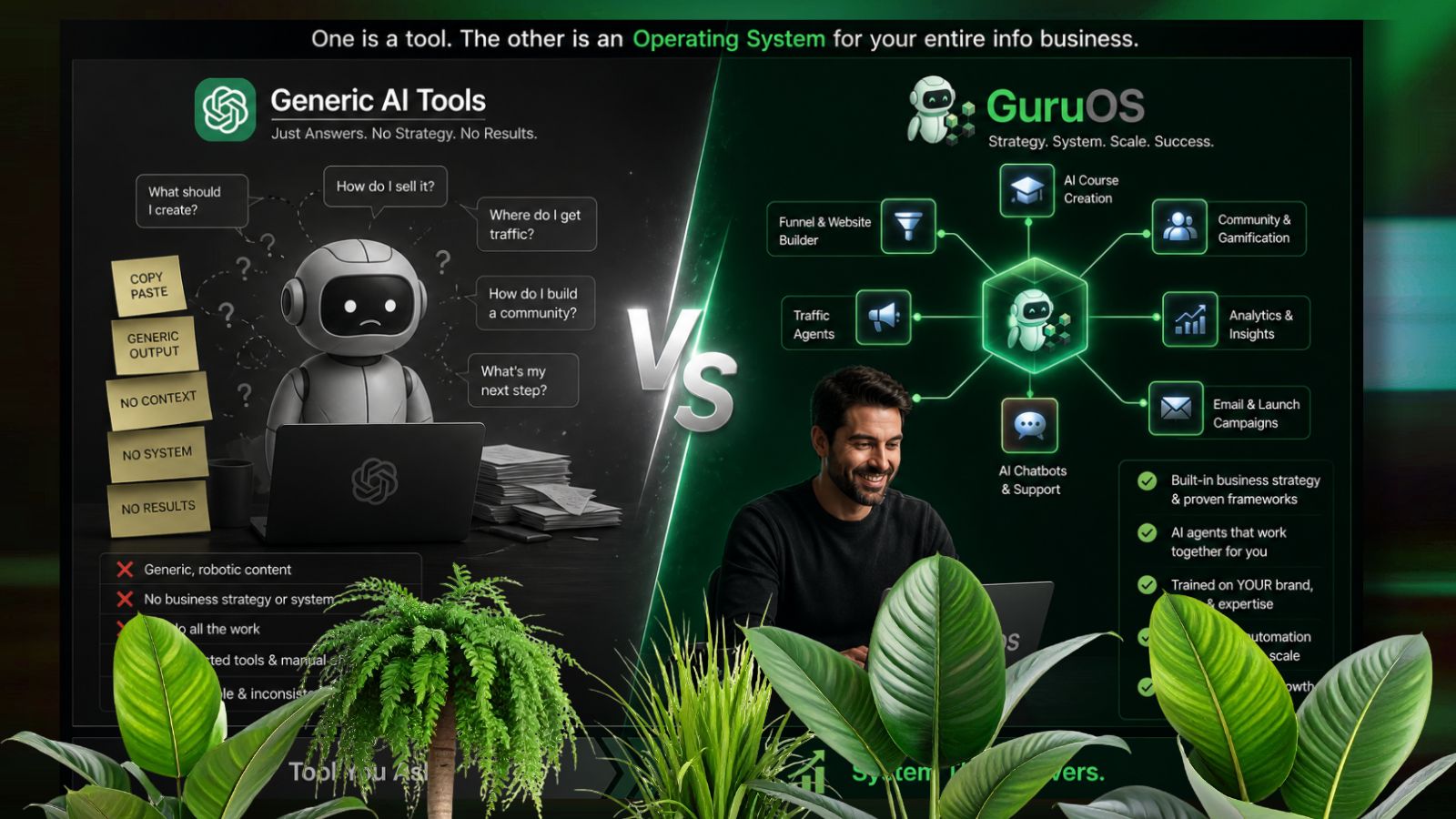
In simple terms, ChatGPT is a general-purpose AI assistant, while GuruOS is a coordinated AI operating system built specifically for launching and scaling info businesses. ChatGPT generates individual outputs, whereas GuruOS connects multiple AI agents together to automate courses, funnels, communities, marketing, and traffic generation.
Why do generic AI tools often fail creators?
Most people start with ChatGPT because it’s fast and flexible.
You can:
- Generate ideas
- Write emails
- Create outlines
- Brainstorm content
However, problems appear once you try turning those outputs into an actual business.
What happens after generating content?
Users still need to:
- Build funnels
- Create landing pages
- Design products
- Organize systems
- Launch campaigns
- Manage communities
That’s where the process becomes fragmented.
Instead of running a business, creators end up managing workflows between multiple apps.
Why does AI-generated content often feel generic?
This is one of the biggest frustrations creators mention.
Why do ChatGPT outputs start sounding repetitive?
Generic AI tools rely heavily on prompts.
Therefore:
- Anyone can generate similar outputs
- Branding becomes inconsistent
- Courses feel shallow
- Marketing lacks personality
As more people use the same AI systems, standing out becomes harder.
According to the GuruOS product materials, this exact issue is one reason the platform was created.
The platform focuses heavily on creating AI systems trained on:
- Your voice
- Your frameworks
- Your business style
- Your niche positioning
The key idea is differentiation.
How does GuruOS fix the “generic AI” problem?
This is where the platform becomes very different from standard AI tools.
What makes GuruOS more than a chatbot?
GuruOS uses multiple specialized AI agents instead of one conversational assistant.
These include:
- Course agents
- Funnel agents
- Traffic agents
- Coaching agents
- Community agents
Each agent has a specific role.
However, they all work together inside the same operating system.
Why does coordination matter?
Most AI tools operate independently.
For example:
- One tool writes copy
- Another builds funnels
- Another schedules posts
GuruOS connects these workflows into one ecosystem.
As a result, everything stays aligned with your brand and business strategy.
How does GuruOS create more unique products?
According to the JV documentation, GuruOS trains the operating system using uploaded:
- PDFs
- Documents
- Notes
- Links
- Brand information
Once trained, the AI agents generate outputs based on your specific knowledge and positioning.
That changes the quality dramatically.
What does this look like in practice?
Instead of generating random generic lessons, the system can:
- Structure complete courses
- Build transformation-focused modules
- Design branded visuals
- Create launch campaigns
- Generate AI coaching systems
Everything reflects your niche and voice more closely.
Can ChatGPT build and launch an entire info business?
Technically, yes—but not efficiently.
What would a typical ChatGPT workflow require?
You would still need:
- Funnel software
- Course hosting
- Community tools
- Marketing automation
- Design systems
- Social schedulers
Additionally, you’d need to manually connect everything yourself.
That’s where many beginners get overwhelmed.
How does GuruOS simplify the process?
GuruOS combines:
- Product creation
- Funnel building
- Membership portals
- AI communities
- Traffic generation
- Chatbot systems
- Payment integrations
Into one platform.
Therefore, creators spend less time switching tools and more time refining offers.
How do GuruOS AI agents automate marketing?
This is one area where the platform stands out strongly.
According to the product information, traffic agents can:
- Create social campaigns
- Generate branded content
- Schedule promotions
- Produce lead-generation assets
Additionally, marketing agents can:
- Write headlines
- Build sales copy
- Create launch pages
- Generate email content
This creates a much more complete business system than using ChatGPT alone.
Is GuruOS easier for beginners than ChatGPT workflows?
For many users, yes.
Why do beginners struggle with generic AI tools?
ChatGPT gives answers.
However, it doesn’t give infrastructure.
New users often don’t know:
- Which prompts to use
- How to structure products
- How to build funnels
- How to launch properly
GuruOS attempts to guide that process more directly.
What helps beginners inside GuruOS?
The platform includes:
- Prebuilt workflows
- Coordinated AI systems
- Structured launch processes
- The GuruOS Blueprint Academy training
According to the JV documents, the training is based on frameworks behind multiple six-figure launches and over $20M in sales experience.
That strategic layer matters a lot.
Does GuruOS replace ChatGPT completely?
Not necessarily.
Many advanced users may still use ChatGPT for:
- Quick brainstorming
- Research
- Idea generation
However, GuruOS focuses on business execution.
That’s an important distinction.
What’s the real advantage of GuruOS?
The platform reduces:
- Tool overload
- Workflow fragmentation
- Generic branding
- Manual coordination
Instead of isolated AI outputs, you get a connected business ecosystem.
Why are creators moving toward AI operating systems?
AI is evolving quickly.
However, creators are learning that:
- Content generation alone isn’t enough
- Business systems matter more
- Brand consistency matters more
- Workflow integration matters more
That’s why platforms like GuruOS are attracting attention.
The future likely belongs to AI systems that coordinate execution—not just generate text.
Final thoughts on GuruOS vs ChatGPT
The comparison between GuruOS vs ChatGPT is really about purpose.
ChatGPT is an incredibly powerful AI assistant.
However, it was not specifically built to run complete info businesses automatically.
GuruOS is trying to solve a different problem entirely.
Instead of helping with isolated tasks, it aims to connect:
- Product creation
- Funnels
- Communities
- Marketing
- Traffic generation
- AI coaching
Into one automated ecosystem.
For creators tired of fragmented workflows and generic AI outputs, that could become increasingly valuable as competition grows.
If you want to explore how the coordinated AI agent system works in real-world scenarios, you can review the complete GuruOS automation breakdown for a deeper explanation of the platform’s workflow structure.
Or, if you’d rather see how the AI agents operate visually inside the platform, you can watch the official GuruOS system walkthrough to understand how the business automation process actually functions.
If you’d like a practical framework showing how creators are moving from disconnected AI tools to complete AI business systems, there’s a detailed visual guide available below that explains the transition step by step.