Who owns BookBloom AI-generated artwork, and can authors use it commercially? The honest answer is that authors should not assume they automatically own every AI-generated image or have unrestricted commercial rights simply because they created it with BookBloom. Your right to use, publish, sell, or modify an image depends on the platform’s current licence and terms, as well as applicable copyright law. Before using BookBloom artwork on a book cover, in paid advertising, or in products for sale, check the specific rights granted to your account. If you’re considering the platform, you can take a closer look at BookBloom here.
Does BookBloom Give Authors Ownership of AI-Generated Artwork?
There is an important difference between having permission to use an image and legally owning its copyright. A software platform may allow customers to download and use generated artwork without transferring exclusive copyright ownership. It may also grant a commercial-use licence while retaining certain rights over the service, technology, or generated material.
For BookBloom specifically, the current terms and licence should be treated as the deciding documents. Unless those documents clearly state what rights are granted, it would be misleading to promise that every image belongs exclusively to the user. Check whether the licence covers personal use, commercial projects, modification, redistribution, and use in products that are sold.
Can Authors Use BookBloom Images Commercially?
Commercial use means using an image in connection with a business or revenue-generating activity. For an independent author, that could include:
- Promotional graphics for an ebook or paperback.
- Images used in social media campaigns and Pinterest pins.
- Artwork included in a book launch or advertising campaign.
- Visuals on an author website or book landing page.
- Promotional materials for a series, newsletter, or reader community.
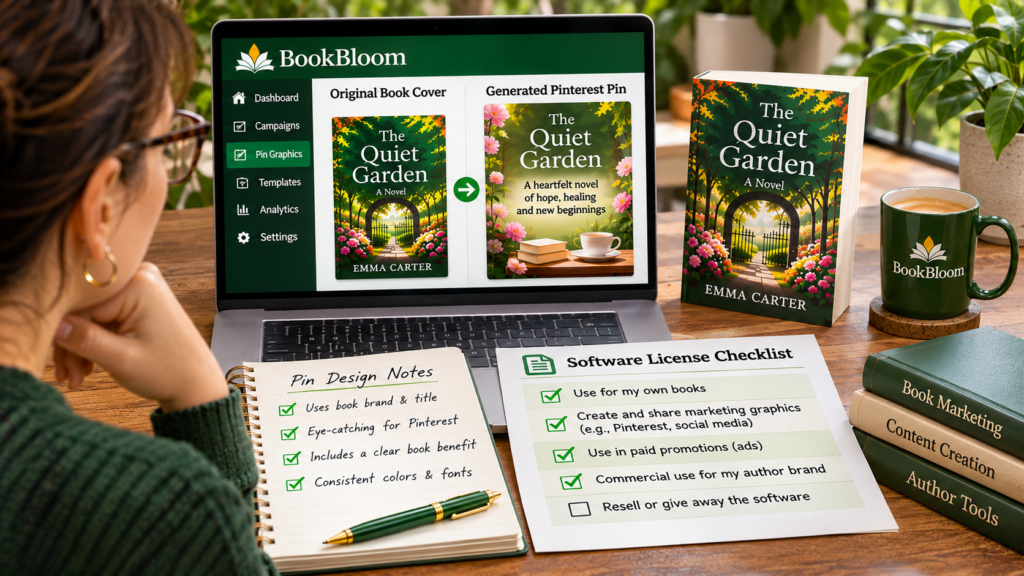
These are common author use cases, but they should not be interpreted as confirmation that BookBloom’s licence permits every one of them. Before publishing, verify whether the licence allows commercial promotion and whether any restrictions apply to book covers, merchandise, client work, or resale of the artwork itself.
What Should You Check in BookBloom’s Licence?
Do not rely on a general statement such as “commercial use included” without reading the conditions. Look for clear answers to these questions:
- Who receives the usage rights? Does the licence grant rights to the account holder, the purchaser, or another named party?
- Is commercial use explicitly allowed? Look for permission to use generated images in products, advertising, and promotional materials that support a business.
- Are there restrictions on resale? Permission to use artwork in a book promotion does not necessarily mean you can sell the image as a standalone stock asset or digital download.
- Can you edit and adapt the images? Check whether cropping, adding text, combining elements, and making other modifications are permitted.
- Do the rights continue after cancellation? If access to BookBloom ends, determine whether previously generated and downloaded artwork can still be used.
- Are there prohibited subjects or uses? Check for restrictions involving trademarks, public figures, copyrighted characters, sensitive material, or other protected content.
AI Artwork and Copyright: Why the Distinction Matters
Platform permission and copyright protection are not the same thing. A software licence can grant contractual permission to use an output, but that does not automatically establish that the output qualifies for copyright protection or that the user owns exclusive rights against everyone else.
Copyright rules for AI-generated material vary by jurisdiction and can depend on the amount of meaningful human creative contribution. For example, an author who makes substantial original creative choices, edits an image, combines it with other original elements, and produces a distinctive final design may have a different legal position from someone who simply enters a short prompt and downloads the result. The precise outcome depends on the facts and the applicable law.
There is also a separate issue: an AI-generated image could unintentionally resemble an existing protected work, brand, or character. A commercial-use licence from a platform should not be treated as a guarantee that every output is free from third-party rights claims.
How Authors Can Reduce Risk Before Publishing
A sensible workflow protects both your creative work and your publishing business:
- Read the current BookBloom terms and any separate commercial licence before relying on generated artwork.
- Save a copy of the applicable terms and the date you accepted them.
- Keep original prompts, downloaded files, and records of meaningful edits.
- Avoid prompts requesting recognisable copyrighted characters, logos, or imitations of specific artists.
- Review every image carefully before using it on a paid book cover or in advertising.
- Seek qualified legal advice if the artwork will be central to a valuable commercial project.
Is BookBloom Suitable for Authors Who Need Commercial Artwork?
BookBloom may be worth considering as part of an author’s promotional workflow if its artwork tools fit the way you market books. AI-assisted visuals can help authors develop graphics for campaigns, social posts, and other promotional activities. However, creative convenience should not replace licence verification.
If commercial rights are essential to your decision, make that a purchase requirement rather than an assumption. Review the exact plan you intend to buy, check whether its licence differs from other account levels, and ask BookBloom support for written clarification if the wording is unclear. You can also read our complete BookBloom review for a broader look at the platform and its author-marketing workflow.
Frequently Asked Questions
Do authors automatically own images created with BookBloom?
Not necessarily. Ownership and usage permission are separate issues. Authors should check BookBloom’s current terms and licence to establish what rights are actually granted.
Can I put BookBloom AI artwork on an Amazon KDP book cover?
Only after confirming that your BookBloom licence permits the intended commercial use and checking the applicable KDP content and publishing requirements. Do not assume that permission to create an image automatically covers every publishing use.
Can I sell BookBloom-generated images as digital products?
That is different from using an image to promote your own book. Check whether the licence expressly permits resale, redistribution, or inclusion in products where the artwork itself is a principal part of what customers purchase.
Does a commercial-use licence guarantee copyright protection?
No. A commercial-use licence may grant permission to use an output, but copyright eligibility and ownership depend on applicable law and the human contribution involved.
Final Verdict
BookBloom AI-generated artwork could be useful for authors who want to create book marketing visuals, but the key question is not simply whether you can download an image. It is exactly what the current licence allows you to do with it. Do not assume exclusive ownership, unrestricted resale rights, or permanent commercial permission without clear written terms. Verify those details first, retain your records, and then decide whether BookBloom fits your publishing workflow.
For the full platform overview and buying considerations, visit the BookBloom review here.