
Building an online education business used to mean stitching together multiple tools.
One platform for courses. Another for communities. Another for funnels and automation.
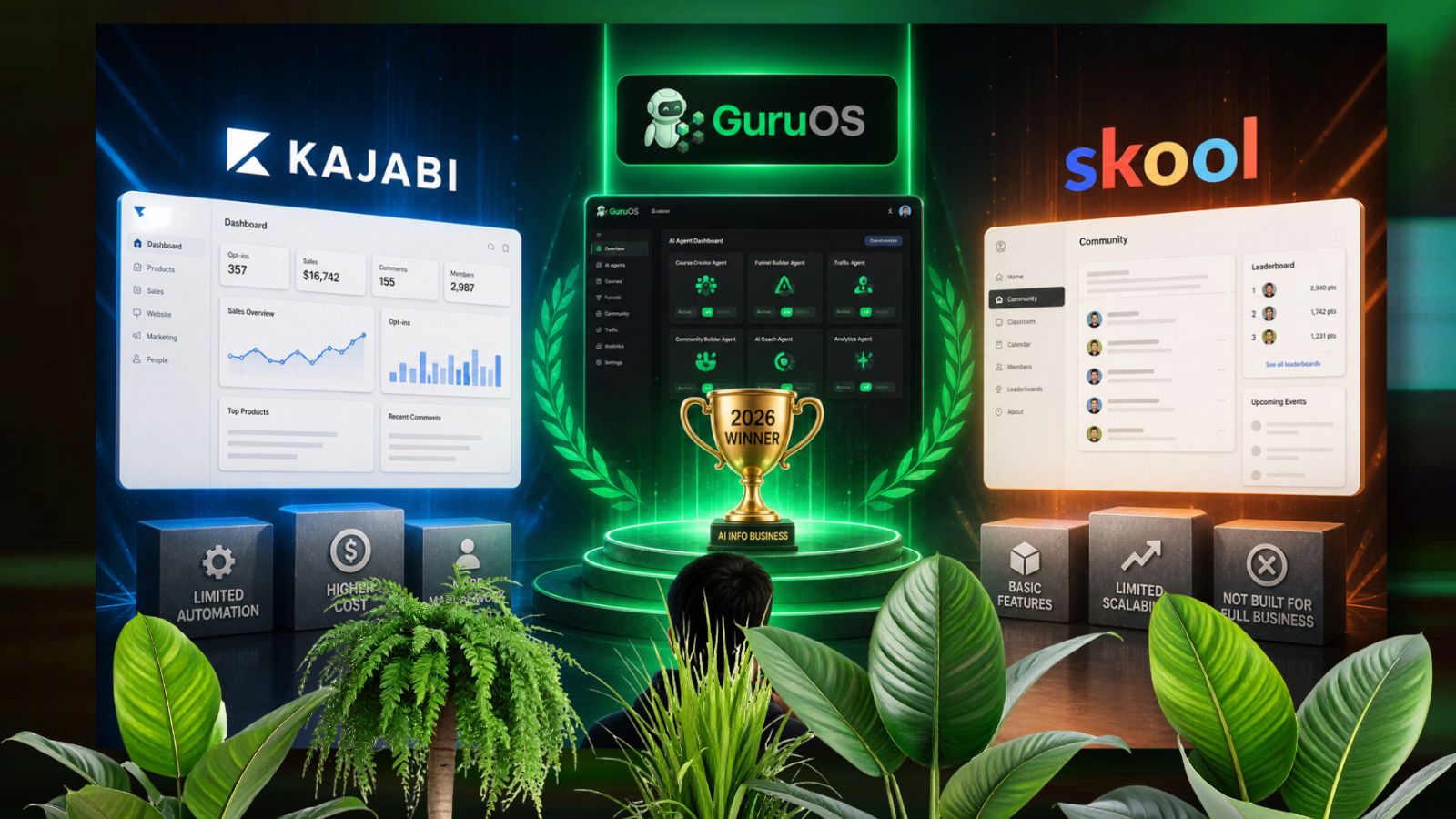
That’s why many creators are now comparing GuruOS vs Kajabi and Skool to see which platform actually makes running an AI-powered info business easier in 2026.
If you’re overwhelmed by subscriptions, disconnected systems, and generic AI tools, you’re not alone. The real question is no longer just “Which platform is best?” — it’s which one helps you build and scale faster without adding complexity.
Which platform is best for AI info businesses in 2026?
In simple terms, GuruOS is designed for automation-first AI info businesses, while Kajabi focuses more on polished course hosting and Skool emphasizes community engagement. The key difference is that GuruOS combines AI agents, funnels, traffic generation, gamification, and product creation into one coordinated operating system.
Why are creators comparing GuruOS vs Kajabi so heavily right now?
Kajabi has been one of the most popular all-in-one course platforms for years.
It offers:
- Course hosting
- Email marketing
- Funnels
- Memberships
However, many creators now want more automation instead of manually building everything.
That’s where GuruOS enters the conversation.
According to the GuruOS product information, the platform uses specialized AI agents trained on your business, style, and content to help create products, launch campaigns, generate traffic, and even manage communities automatically.
Instead of simply hosting content, GuruOS aims to function like a complete “business operating system.”
How does GuruOS compare to Kajabi for automation?
This is probably the biggest difference.
What does Kajabi still require you to do manually?
With Kajabi, users still need to:
- Build courses manually
- Create landing pages
- Write sales copy
- Manage launches
- Plan traffic strategies
Kajabi gives you flexibility, but you still handle most execution yourself.
How does GuruOS reduce manual work?
GuruOS approaches things differently.
Its AI agents can:
- Create structured video courses
- Build eBooks and PDFs
- Generate landing pages
- Write launch copy
- Create social campaigns
- Run gamified communities
Therefore, instead of using AI for isolated tasks, GuruOS connects everything together.
Here’s what actually matters:
The platform is built around the idea of reducing operational overload for info entrepreneurs.
Is GuruOS better than Skool for community businesses?
Skool has become extremely popular because of its clean interface and strong community features.
However, Skool focuses mainly on:
- Community interaction
- Courses
- Group engagement
It’s intentionally simple.
That simplicity is helpful for some creators.
However, it also means you’ll likely need external tools for:
- Funnels
- Automation
- AI content
- Traffic generation
- Lead capture
GuruOS attempts to solve this by combining community features with automation and AI systems.
According to the JV documentation, GuruOS includes:
- Referral gamification
- AI engagement systems
- Leaderboards and rewards
- AI-generated content scheduling
- Built-in chatbot agents
- Membership portals
As a result, users can build “living communities” that continue growing without constant manual management.
What makes GuruOS different from generic AI tools?
Many creators are now using ChatGPT and other AI tools alongside Kajabi or Skool.
The problem?
Those tools often produce disconnected workflows.
Why do generic AI setups become frustrating?
Most users still need to:
- Copy and paste content
- Build systems manually
- Organize multiple platforms
- Create branding consistency themselves
This creates friction.
GuruOS tries to eliminate that friction through coordinated AI agents.
How do GuruOS AI agents work together?
The system includes:
- Course agents
- Traffic agents
- Coaching agents
- Funnel agents
- Community agents
Instead of isolated prompts, the agents operate as a connected ecosystem trained on your business.
That’s a major shift from standard AI workflows.
Can GuruOS replace multiple subscriptions?
For many users, yes.
Traditional creator stacks often include:
- Kajabi or Teachable
- ClickFunnels
- ConvertKit
- Community platforms
- Canva
- AI writing tools
Costs add up quickly.
However, GuruOS combines:
- Course creation
- Funnel building
- AI coaching
- Traffic generation
- Communities
- Payment systems
- Marketing automation
This “all-in-one AI operating system” approach is one of its biggest selling points.
Which platform is easier for beginners?
This depends on what type of user you are.
Kajabi works well if:
- You want polished course hosting
- You prefer manual control
- You already understand marketing
Skool works well if:
- Community is your main focus
- You want simplicity
- You already have traffic sources
GuruOS works well if:
- You want AI automation
- You want fewer tools
- You’re building an info business from scratch
- You prefer guided systems
In simple terms, GuruOS reduces the technical learning curve more aggressively than the other two platforms.
Does GuruOS have features Kajabi and Skool don’t offer?
Yes — especially around AI automation.
Some standout features include:
- AI-powered course agents
- Automated social campaigns
- AI coaching agents
- Traffic generation agents
- Referral gamification systems
- Operating-system-style agent coordination
Additionally, GuruOS includes access to the GuruOS Blueprint Academy, which teaches the exact launch framework behind multiple six-figure product launches.
That educational component is something many competitors don’t include.
So which platform actually wins in 2026?
The answer depends on your goals.
If you want:
- Simple communities → Skool works well
- Traditional course hosting → Kajabi remains solid
- AI-driven automation and scaling → GuruOS stands out
The key idea is this:
Kajabi and Skool are platforms. GuruOS is positioning itself as an automated business ecosystem.
That distinction matters more as AI becomes central to online business operations.
Final thoughts on GuruOS vs Kajabi and Skool
The comparison between GuruOS vs Kajabi is really about workflow and automation.
Kajabi and Skool are still excellent platforms.
However, GuruOS is trying to solve a newer problem: how to automate and connect the entire info-business process using coordinated AI systems.
For creators who feel overwhelmed by too many tools, disconnected AI workflows, and manual launches, that approach could be extremely valuable.
If you want to see a deeper breakdown of how the automation system works in real-world scenarios, you can explore the full GuruOS comparison and feature analysis for additional insights.
Or, if you prefer seeing the platform in action first, you can watch the official GuruOS walkthrough to understand how the AI agents, funnels, and communities actually work together.
If you’d like a practical checklist showing how creators are replacing multiple subscriptions with one AI-powered system, there’s a detailed resource available below that breaks the process down step by step.