
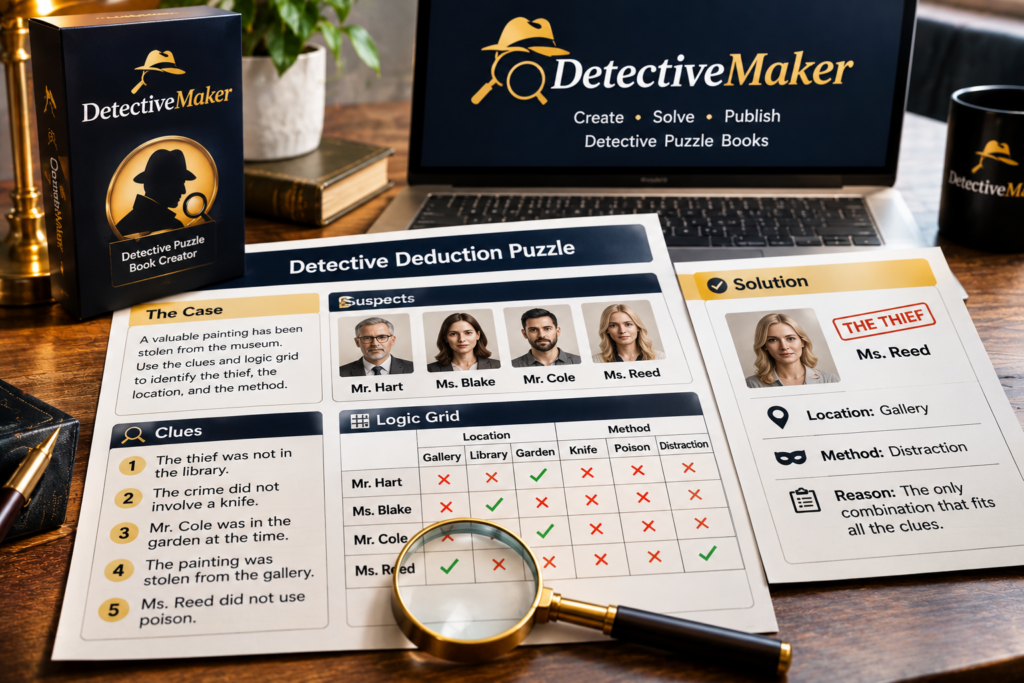
Short answer: Detective Maker can generate deduction grids and corresponding puzzle solutions, but the available product information does not confirm that it includes a separate automated validation engine that guarantees every puzzle is logically solvable. You should therefore treat its generated grid and answer as a starting point, then manually test the clues and solution before publishing. You can explore Detective Maker’s puzzle-generation features to see how the creation workflow fits your needs.
What Validation Features Does Detective Maker Provide?
Based on the available product information, Detective Maker generates several connected parts of a detective puzzle:
- Case story: The narrative that introduces the mystery.
- Suspects: The people who may be connected to the case.
- Weapons and locations: The possible objects and places involved.
- Clues and evidence: Details readers use to investigate the mystery.
- Deduction grid: A structured way to compare possibilities and eliminate incorrect combinations.
- Solution: The intended answer to the puzzle.
Generating both a deduction grid and a solution is useful because it gives the creator the basic components needed to test a puzzle. However, generating these elements is not the same as independently verifying that the puzzle has exactly one valid answer.
Important distinction: The product information describes AI-generated grids and solutions, but does not establish that Detective Maker automatically checks every clue for contradictions, verifies uniqueness or certifies that every puzzle is solvable.
How Can You Check Whether a Detective Maker Puzzle Is Solvable?
Even when an AI tool generates a complete mystery, the creator should check whether the clues logically support the intended answer. A practical validation process involves working backward from the solution and then solving the puzzle without looking at that answer.
1. Check the Puzzle Categories
Start by listing the categories involved in the mystery. A typical example might include suspects, locations and weapons. Check that the story, clues and deduction grid use the same names and options consistently.
For example, if the case introduces four suspects, make sure the grid does not accidentally omit one or introduce an unrelated name.
2. Compare Every Clue With the Intended Solution
Read each clue and determine what information it actually provides. A clue should help readers identify a relationship, eliminate a possibility or narrow down the available choices.
Check for problems such as:
- A clue that contradicts the intended solution.
- Two clues that appear to give incompatible information.
- A clue that refers to a suspect, location or weapon not included in the grid.
- Missing information that prevents readers from reaching the intended answer.
3. Solve the Grid Without Looking at the Answer
Cover the generated solution and attempt to solve the puzzle using only the story, clues and deduction grid. Follow the clues one at a time and record which combinations can be eliminated.
If you cannot reach the intended answer, investigate whether the puzzle is missing a clue or whether the information is ambiguous. If you can reach several different answers, the puzzle may need additional constraints.
4. Check for One Consistent Solution
A strong deduction puzzle should lead to a clear, consistent answer. Check whether the clues support the intended combination and rule out competing combinations. If more than one answer remains possible, revise the clues or other puzzle details.
5. Review the Final Puzzle Pages
Once the logic has been checked, inspect the visual presentation. Confirm that the grid is readable, the clues are easy to follow and the solution is displayed where readers can find it. A logically correct puzzle can still be frustrating if its instructions or layout are confusing.
What Happens If AI Generates an Incorrect Solution?
AI-generated puzzle content can require editing. A story may sound convincing while containing a clue that does not support its answer. A deduction grid may also need adjustments if its categories or details do not match the narrative.
Detective Maker includes a visual editor that lets users modify generated content and arrange page elements using drag-and-drop blocks. Its editing capabilities provide a way to refine the material, but they should not be confused with proof that the underlying puzzle logic has been automatically verified.
If you are considering the tool, review Detective Maker’s features and available package options alongside your intended puzzle-creation workflow.
Does Detective Maker Automatically Guarantee Solvable Puzzles?
There is no confirmed information in the available product details establishing an automatic solvability guarantee or a dedicated logic-validation report. The product does generate deduction grids and solutions, which can help creators assemble and review their puzzles, but the final quality check remains important.
Before publishing, use this simple checklist:
- Every suspect, weapon and location is consistent throughout the case.
- All clues are understandable and relevant.
- No clue contradicts another clue or the intended solution.
- The deduction grid includes the correct categories and options.
- The puzzle can be solved using the information provided.
- The clues lead to one consistent intended answer.
- The displayed solution matches the completed grid.
Frequently Asked Questions
Does Detective Maker generate logic grids?
Yes. Its listed features include generating deduction grids alongside detective stories, suspects, weapons, locations, clues, evidence and solutions.
Does Detective Maker check whether every puzzle has one solution?
An automatic uniqueness checker is not confirmed in the available product information. Creators should manually test whether the clues lead to one consistent answer.
Can I edit a puzzle if its clues are incorrect?
Yes. Detective Maker includes a visual editor for modifying generated content and arranging puzzle components. You can use it to refine the material before publishing.
Why should I test an AI-generated detective puzzle?
Testing helps identify contradictory clues, missing information, ambiguous answers and mismatches between the grid and solution. These problems can make an otherwise interesting mystery difficult or impossible to solve.
Final Thoughts: Is Detective Maker Suitable for Creating Solvable Logic Puzzles?
Detective Maker can help create the building blocks of a detective logic puzzle, including AI-generated case stories, clues, evidence, deduction grids and solutions. However, the available product information does not confirm a dedicated automated validation system that guarantees logical consistency or a unique answer. Creators should manually solve and check each puzzle before publishing it. If you want to assess the wider feature set, pricing and upgrade options, read the complete Detective Maker review and buying guide.