
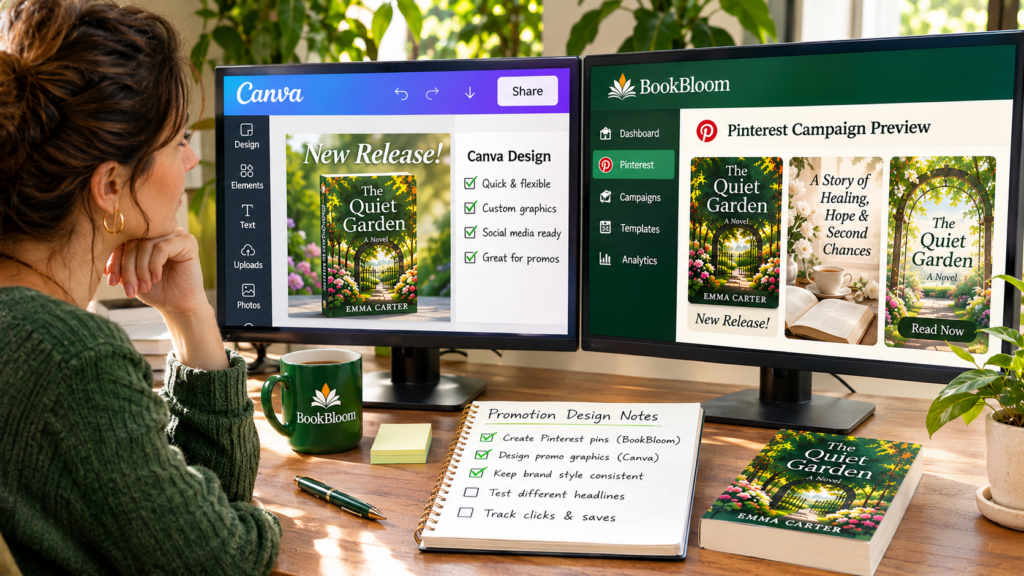
BookBloom is the more relevant option if your main goal is to create and organise book-specific promotional content, while Canva is the stronger choice if you want broad creative control over graphic design. The better tool depends on whether you need an author-focused marketing workflow or a flexible design platform. BookBloom is positioned around book promotion, including AI-assisted artwork and marketing content, whereas Canva offers a general-purpose visual design environment with extensive templates and editing options. If you want to explore BookBloom’s current offer, take a look at it here.
1. Understanding the Difference Between BookBloom and Canva
Although BookBloom and Canva can both be relevant when creating book promotion graphics, they approach the task from different directions.
BookBloom is designed around the needs of authors promoting books. Its positioning includes AI-assisted artwork and copywriting, alongside book marketing organisation features such as a content calendar and book pages. The aim is to bring several book promotion activities into a more focused workflow.
Canva is a general-purpose graphic design platform. Authors can use it to create book launch graphics, Pinterest Pins, social media posts, promotional banners, quote cards, reading lists, and many other visual assets. It provides templates and editing tools that allow users to customise designs for different purposes.
The main distinction is therefore specialisation versus flexibility: BookBloom focuses on the book marketing process, while Canva focuses on visual content creation across many industries and use cases.
2. Creating Book Promotion Graphics With BookBloom
For an author, the advantage of a book-focused workflow is that promotional tasks can be considered in the context of a specific title and its intended readers. Rather than approaching every graphic as an isolated design project, you can think about how artwork, promotional copy, and a publishing schedule work together.
BookBloom’s AI artwork and copywriting positioning may appeal to authors who want assistance developing promotional material without starting every task from a blank page. Its calendar and book page features also relate to the wider process of organising and presenting a book.
This can be useful when you are planning a launch, promoting several titles, or trying to maintain a regular stream of book-related content. However, AI-generated artwork and copy still need human review. Check that the book cover, title, genre, tone, and promotional message are represented accurately before publishing anything.
3. Creating Book Promotion Graphics With Canva
Canva is particularly useful when you want detailed control over the appearance of your promotional graphics. Its template-based design environment can help authors produce a wide range of assets, including:
- Pinterest Pins and promotional graphics.
- Instagram posts, stories, and carousel designs.
- Book launch announcements and countdown graphics.
- Character quotes and memorable passages.
- Author introduction and reader engagement posts.
- Promotional banners and visual assets for websites.
You can customise layouts, colours, typography, images, and other visual elements to match your author brand. This makes Canva useful for authors who enjoy designing or want precise control over the final appearance of each graphic.
The trade-off is that you need to spend time selecting templates, adjusting designs, and preparing content. Canva helps with the design process, but it does not automatically create a complete book marketing strategy for you.
4. BookBloom vs Canva: A Practical Comparison
The following comparison focuses on the main differences in how authors may use the two platforms. Exact capabilities, plan limits, and available features should always be checked against the current product offers.
| Consideration | BookBloom | Canva |
|---|---|---|
| Main focus | Book marketing and promotion workflow | General graphic design and visual content |
| Artwork approach | AI-assisted artwork positioning for book promotion | Templates and visual design tools |
| Promotional copy | AI copywriting is part of its positioning | Primarily a design environment, with additional AI tools depending on plan and availability |
| Content organisation | Includes a book marketing calendar in its feature positioning | Design and project organisation tools |
| Creative control | Depends on the available generation and editing workflow | Broad manual design customisation |
| Best fit | Authors seeking a book-focused promotional workflow | Users creating many kinds of visual content |
5. Which Tool Is Better for Pinterest Book Promotion?
Both tools may have a role in a Pinterest marketing strategy, but the best choice depends on how you prefer to work.
If you want help developing book-related artwork and promotional copy as part of a wider marketing routine, BookBloom’s author-focused approach may be appealing. If you want to create highly customised Pins, experiment with layouts, or maintain precise visual consistency across multiple boards, Canva offers a flexible design environment.
Whichever tool you choose, remember that attractive graphics alone do not guarantee Pinterest traffic. Use descriptive Pin titles, relevant keywords, clear images, and useful descriptions. Link each Pin to a relevant destination and create content that matches what your intended readers are searching for.
6. Can You Use BookBloom and Canva Together?
Yes. You do not necessarily have to treat BookBloom and Canva as competing tools. An author could use a book-focused workflow to plan promotional ideas and develop initial artwork or copy, then use a design platform when more detailed visual adjustments are needed.
This approach may be useful if you manage multiple books or want a consistent author brand across Pinterest, Instagram, and other channels. Before combining tools, check the available export options, image quality, usage rights, and any relevant plan restrictions. Avoid paying for overlapping features unless the additional flexibility is worth the cost.
For a closer look at BookBloom’s positioning and the wider book promotion workflow, read the full BookBloom review here.
Final Verdict: BookBloom or Canva for Book Promotion Graphics?
Choose BookBloom if your priority is a more specialised book marketing workflow that brings AI-assisted promotional artwork and copywriting together with author-focused organisation features. Choose Canva if your priority is flexible graphic design, extensive template options, and detailed control over the appearance of your promotional content.
For authors who already enjoy designing their own graphics, Canva may be all they need. For authors who want a workflow centred more directly on promoting books, BookBloom may be worth evaluating. The right decision comes down to your preferred process, the features you will actually use, and the total cost of ownership. To make a more informed decision, visit the complete BookBloom review before choosing your next book marketing tool.