
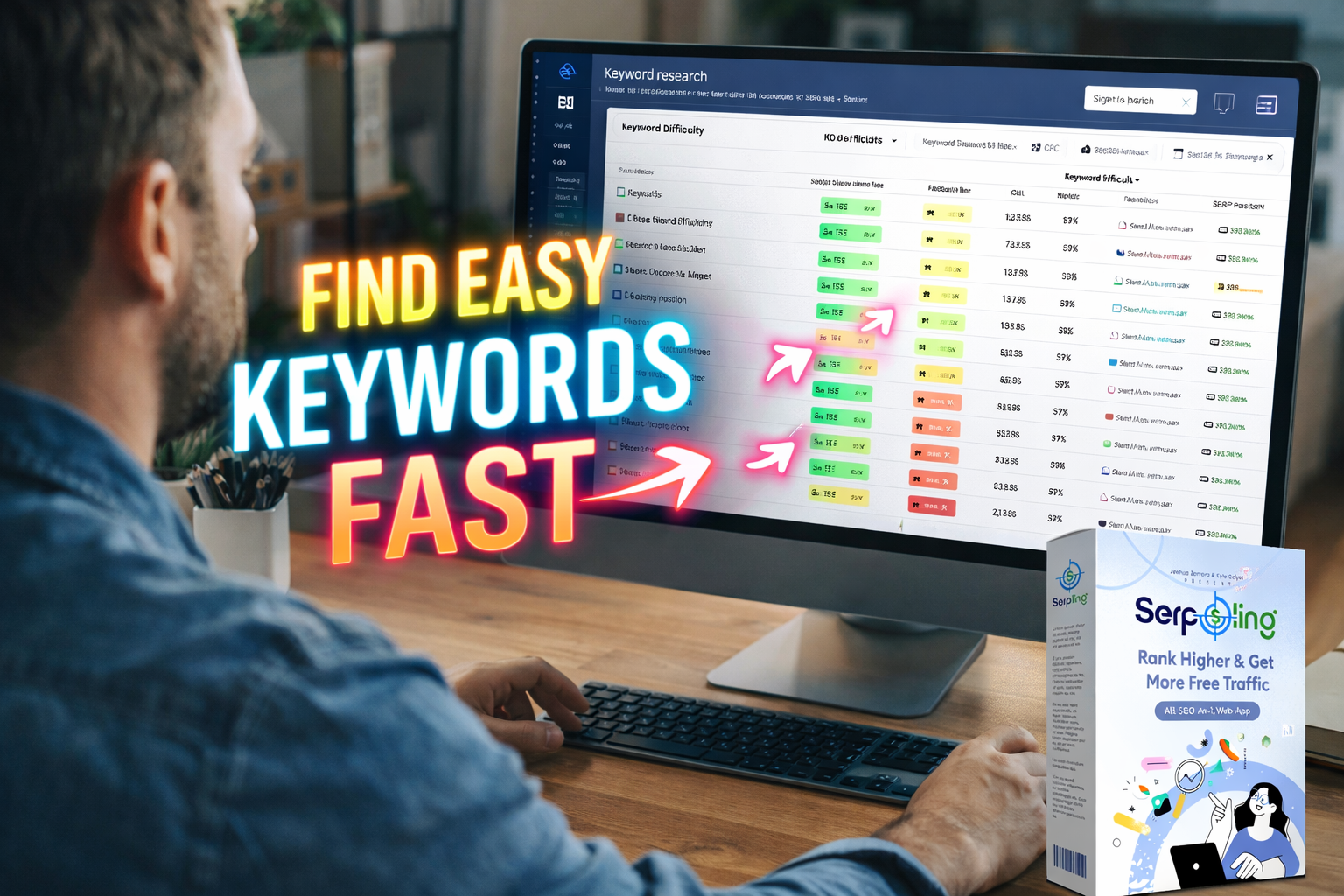
Why is finding low-competition keywords so difficult today?
If you’ve been trying to rank content lately, you’ve probably noticed something frustrating. You pick keywords that tools label as “easy,” yet your content still doesn’t rank.
That’s exactly where SerpSling low competition keywords come into the picture. The problem isn’t just finding keywords. It’s finding the right ones with real ranking potential.
Most tools give you numbers. However, they don’t give you clarity. And that’s where things break down.
How does SerpSling help you find low-competition keywords that rank fast?
In simple terms, SerpSling identifies low-competition keywords by combining difficulty scoring, real SERP data, and competitor analysis—so you don’t just guess, you act with confidence.
Instead of relying on generic metrics, it shows:
- How hard a keyword really is
- What competitors are doing
- What you need to beat them
Therefore, you’re not just picking keywords. You’re choosing winnable opportunities.
What makes SerpSling low competition keywords more reliable?
Here’s what actually matters. Not all “low competition” keywords are equal.
Many tools miss context. SerpSling, however, focuses on actionable data.
It analyzes real ranking requirements
Instead of vague scores, you see:
- Backlinks needed
- Domain strength of competitors
- Content gaps
As a result, you know what it takes before you even start.
It uncovers hidden long-tail opportunities
Using “People Also Search For” data, SerpSling finds keywords that are:
- Less competitive
- Highly targeted
- Easier to rank
This is where most fast rankings actually happen.
It removes guesswork completely
The biggest shift is confidence.
You’re no longer asking:
“Will this rank?”
Instead, you’re thinking:
“I know what to do to rank.”
How would you use SerpSling low competition keywords in real life?
Let’s break it down with a simple use case.
Imagine you’re starting a niche blog.
Step 1: Find keywords
You enter a broad keyword like “email marketing.”
SerpSling suggests long-tail variations with lower competition.
Step 2: Analyze difficulty
You instantly see which keywords are realistic.
Therefore, you avoid wasting time on impossible targets.
Step 3: Study competitors
You click one result and analyze:
- Their backlinks
- Their keyword strategy
- Their ranking structure
Step 4: Create targeted content
Now, instead of guessing, you create content designed to outperform existing pages.
This is where SerpSling low competition keywords stand out. They are not just ideas. They are validated opportunities.
Is SerpSling better than traditional keyword tools?
This is a fair question.
Traditional tools like Ahrefs or SEMrush are powerful. However, they often require experience to interpret data correctly.
SerpSling, on the other hand, simplifies the process.
- It tells you what to do next
- It reduces analysis time
- It focuses on execution
So while other tools give data, SerpSling gives direction.
If you want a deeper breakdown of how it compares and performs in different scenarios, you might want to explore a detailed review that covers its full workflow and features.
Can beginners really rank faster using SerpSling?
Yes, and here’s why.
Beginners usually struggle with:
- Picking the wrong keywords
- Not understanding competition
- Lacking a clear strategy
SerpSling addresses all three.
Because of that, even if you’re new, you can:
- Identify easier keywords quickly
- Understand what ranking requires
- Execute with clarity
That combination is what shortens the time to results.
What should you focus on when using SerpSling?
The key idea is simple.
Don’t just chase low difficulty. Instead, focus on:
- Relevance
- Intent
- Competition quality
SerpSling helps you balance all three.
As a result, you’re not just ranking faster. You’re attracting the right traffic.
Final thoughts
Finding keywords that actually rank is no longer about luck. It’s about using the right data in the right way.
SerpSling low competition keywords give you that advantage. They help you move from uncertainty to clarity.
If you’re curious about how this works in a complete step-by-step setup, you can explore a deeper breakdown that walks through the full process.
Or, if you prefer to see how the tool functions directly, you can check the official page to understand its features and workflow better.