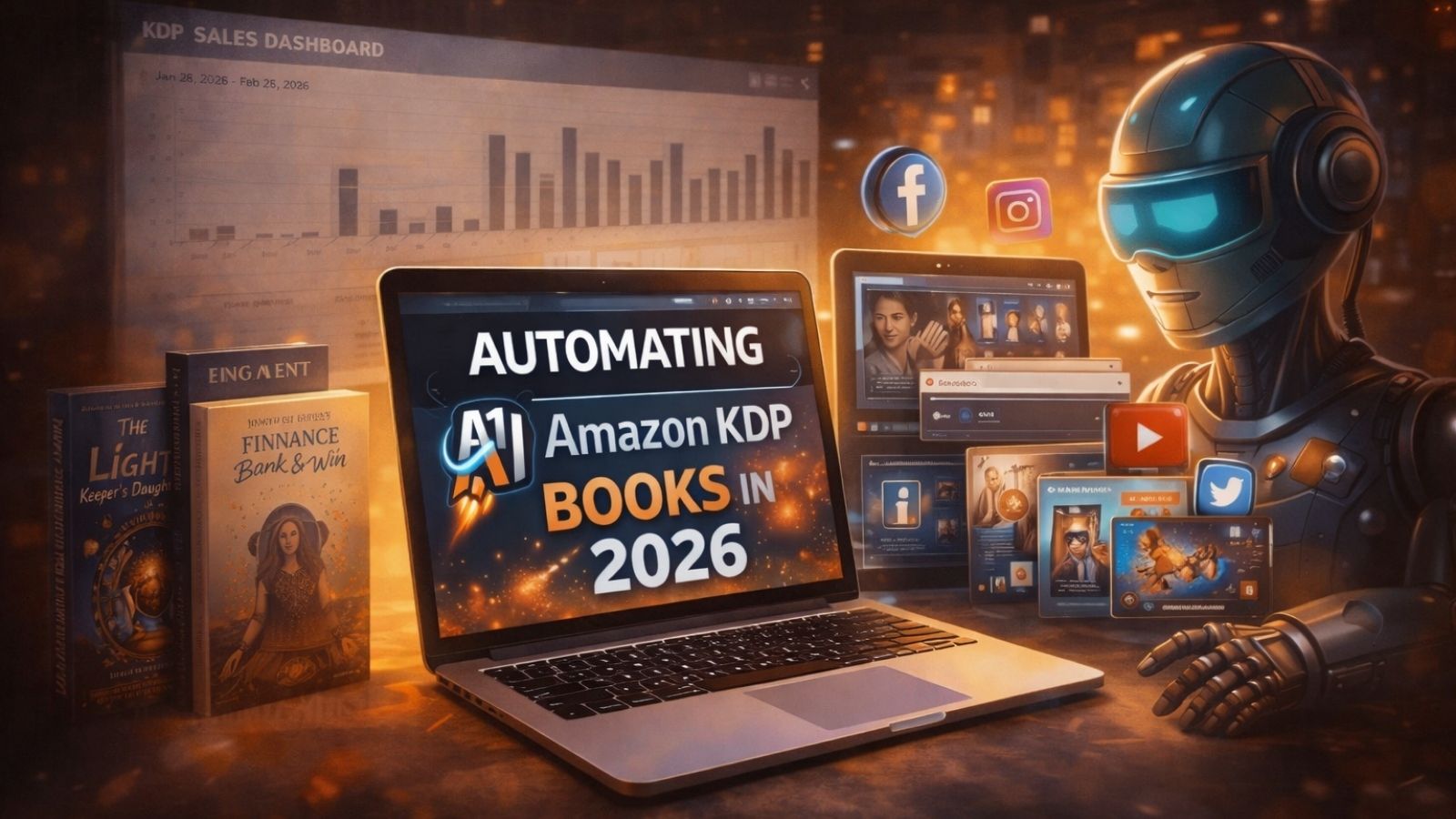
Publishing a book on Amazon KDP has become easier than ever. In fact, thousands of authors publish new titles every single day. But the real challenge begins after the book goes live.
Visibility.
Many authors quickly discover that writing the book was only half the journey. Marketing it consistently becomes the real work. That is why a growing number of KDP publishers are searching for ways to automate book promotion in 2026.
The question many authors are asking today is simple: Can marketing for Amazon KDP books actually be automated, and if so, how does it work in practice?
Understanding the answer requires looking at how book promotion has evolved over the past few years.
Why Are Authors Looking for Automated KDP Marketing Systems?
In online publishing communities, one common frustration keeps appearing. Authors publish their books and then struggle to maintain consistent promotion.
Marketing usually involves a combination of activities such as posting on social media, writing blog content, designing promotional graphics, and engaging with potential readers. Each of these tasks can be time consuming.
For authors managing multiple books, this workload quickly becomes overwhelming. Many eventually stop marketing altogether simply because it requires too much daily effort.
Automation is increasingly being seen as a solution to this problem. Instead of manually creating and publishing promotional content every day, authors can set up systems that generate and distribute marketing content automatically.
This shift reflects a broader trend across online business. Entrepreneurs are increasingly using AI tools and workflow automation to handle repetitive marketing tasks.
What Does Automated KDP Marketing Actually Mean?
Automated book marketing does not mean pushing a single button and instantly generating sales. Rather, it refers to creating systems that consistently promote a book without requiring constant manual effort.
A typical automation workflow might include generating promotional posts from the book itself, scheduling those posts across multiple social platforms, and linking readers directly to the book’s Amazon listing.
When these processes run automatically, the author no longer needs to manually repeat the same promotional tasks every day.
Instead, the marketing engine continues running quietly in the background.
Over time, this steady promotion can help books maintain visibility across different platforms where potential readers already spend time online.
How Are AI Tools Changing Book Promotion?
Artificial intelligence is now playing a central role in marketing automation. Instead of manually writing every promotional caption or designing every social media image, AI systems can generate this content automatically.
This is particularly useful for authors who struggle with the creative side of marketing. Many writers enjoy producing books but find it difficult to continually create promotional material.
AI tools can analyze the content of a book and generate related marketing messages, quotes, and discussion prompts. These can then be used to produce social posts or blog style content.
This approach allows authors to transform their manuscripts into ongoing promotional material rather than starting from scratch each time.
Platforms like AI Sales Rocket were created specifically with this workflow in mind. The software reads the manuscript, generates promotional content, and distributes it across connected social platforms.
If you want to explore how that system works in detail, the full explanation is available in this complete AI Sales Rocket walkthrough and pricing analysis
Can Automation Help Authors Maintain Long Term Book Visibility?
One of the most important benefits of automation is consistency.
Many books disappear from visibility simply because promotion stops. Authors often promote their books heavily during launch week but gradually reduce marketing activity afterward.
Automated systems solve this by continuing to publish promotional content over time. Instead of relying on motivation, the author relies on a system.
This consistency is especially useful for authors who publish multiple books. Rather than treating each title as a separate marketing project, automation allows all books to feed into the same promotional ecosystem.
Each book becomes another asset that contributes to overall visibility.
Over time, this approach can transform publishing from a one-book experiment into a scalable online business.
Are There Limitations to Automated Book Marketing?
Automation can simplify marketing, but it is not a magic solution.
Books still need strong positioning within a niche. Readers must still find the topic interesting, and the book itself must deliver real value. Automation can amplify visibility, but it cannot compensate for weak content.
It is also important for authors to maintain a level of human involvement. Automated systems work best when combined with occasional personal interaction with readers, such as responding to comments or participating in author communities.
In other words, automation should support marketing rather than completely replace it.
Is Marketing Automation Becoming the New Standard for Self Publishing?
Many experienced publishers believe that automation will become increasingly important as the self publishing industry grows.
The number of books published each year continues to increase, and competition for reader attention grows alongside it.
Authors who rely purely on manual promotion may eventually find themselves limited by time. Automation allows marketing to continue even when the author is focused on writing the next book.
This shift mirrors what has already happened in other areas of online business, where automation tools handle many routine marketing tasks.
For authors building a long term publishing portfolio, automation may soon become less of an option and more of a necessity.