

Email marketing has been declared “dead” more times than most online trends. Yet, quietly and consistently, it continues to outperform social platforms when done right. The problem is not email itself. The problem is cost, control, deliverability, and over-reliance on third-party platforms that keep changing the rules.
That is the context in which I-Mail has entered the conversation.
This review takes a grounded look at I-Mail in 2025. Not from a hype angle, but from the perspective of real digital marketers asking practical questions: Does email marketing still work? Is it worth investing in another tool? And can this realistically become a long-term business asset rather than another monthly expense?
What Is I-Mail?
I-Mail is a cloud-based, AI-powered email marketing platform designed to give users full control over their email business. It replaces traditional autoresponders by allowing unlimited email sending, unlimited subscribers, and automation without monthly fees.
The platform is built on the same software that its creator has used personally to send over half a million emails, achieve unusually high open rates, and eliminate recurring autoresponder costs. Instead of renting access to your own list through third-party services, I-Mail positions itself as an owned asset.
At its core, I-Mail combines email broadcasting, automated sequences, AI-assisted email writing, list management, lead capture, and deliverability controls in one system.
👉 👉 Explore what I-Mail actually includes
Why Email Marketing Is Still Profitable (When Done Correctly)
One of the most common discussions across Reddit marketing communities is whether email marketing still delivers results in 2025. The short answer is yes, but only for marketers who control three things: deliverability, costs, and relevance.
Most frustrations stem from:
- Falling open rates
- Accounts being restricted or suspended
- Rising monthly fees as lists grow
- Losing subscribers during migrations
- Lack of flexibility in automation
I-Mail was created specifically in response to these issues. Instead of competing on flashy features, it focuses on ownership, control, and reliability.
👉 👉 See how this model differs from traditional autoresponders
Core Features of I-Mail
AI Email Writer
Users can paste a URL or offer page, and the AI generates a complete promotional email. This directly addresses a frequent pain point among marketers who struggle with copywriting or consistency.
Unlimited Subscribers and Lists
There are no caps on list size or number of lists. This is particularly relevant for affiliates, agencies, and marketers scaling multiple offers.
Broadcasts and Automation Sequences
I-Mail supports both one-time broadcasts and automated follow-up sequences, allowing full funnel communication without external tools.
Deliverability and Sender Control
Instead of sending through shared IP pools, users control their own sending setup. This helps reduce the impact of other senders damaging deliverability.
Exclude List Technology
Buyers can automatically be excluded from future promotional emails, improving open rates and reducing complaints.
Built-In Opt-In Forms and Lead Pages
Lead capture forms and hosted pages are included, eliminating the need for separate landing page tools for simple setups.
Flexible SMTP Options
I-Mail works with Amazon SES, Mail-It, hosting SMTP, Gmail, SMTP2Go, and more. This keeps sending costs low and predictable.
👉 👉 Understand how these features work together in practice
Demo and Walkthrough Overview
Using I-Mail typically follows a straightforward flow:
- Connect a sending method
- Create or import a list
- Write emails manually or with AI
- Set up broadcasts or automated sequences
- Monitor opens, clicks, and engagement
The interface is intentionally kept simple, with tutorials built into the dashboard. For beginners, this reduces friction. For experienced marketers, it removes unnecessary layers.
👉 👉 Watch how the platform operates step by step
Pricing, Funnel Structure, and OTOs
I-Mail is offered as a one-time purchase rather than a subscription.
Front-End Offer
- Lifetime access
- Unlimited emails and subscribers
- Core features included
- No monthly fees
OTOs (Upsells)
- OTO 1: Enhanced features and expanded sending options
- OTO 2: Agency license for client use
- OTO 3: Advanced training and scaling strategies
Exact pricing may vary during launch, and bundle discounts are available directly on the front-end page.
👉 👉 Check current launch pricing and bundle options
Money-Back Guarantee and Launch Urgency
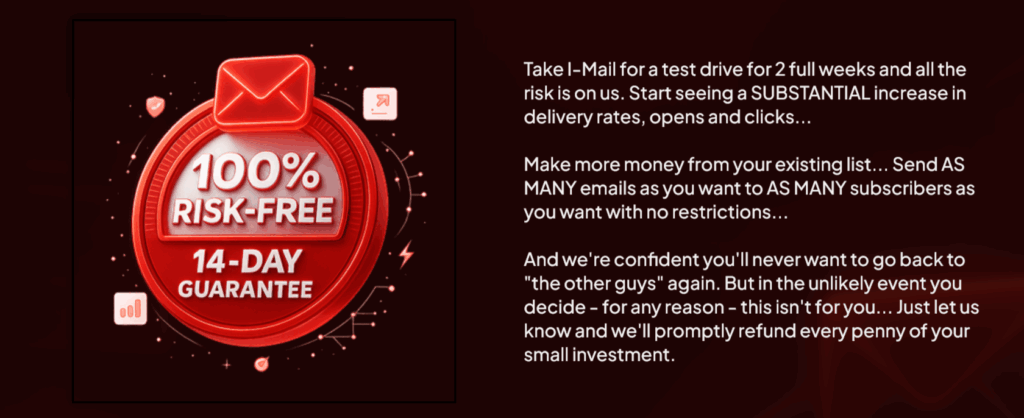
I-Mail comes with a 14-day money-back guarantee, allowing users to test the platform without long-term risk.
The launch offer is time-limited, and pricing is expected to increase once the launch window closes. If urgency tools such as timers are used, they reflect the genuine launch structure rather than artificial scarcity.
Vendor Bonuses Included Free
All bonuses are delivered inside the members area at no extra cost.
These include:
- Done-for-you email swipes
- Proven subject lines based on real campaigns
- Training resources for setup and optimization
- Access to case studies and interviews
- Additional tools that enhance list building and automation
These bonuses are designed to shorten the learning curve and help users implement faster rather than start from scratch.
👉 👉 Review everything included at no additional charge
About the Creator: Brett Rutecky

Brett Rutecky is a long-time digital marketer known for building tools he actively uses in his own business. Rather than outsourcing development, he created I-Mail after experiencing account restrictions, deliverability drops, and revenue losses from third-party autoresponders.
His credibility comes less from marketing claims and more from usage. I-Mail is not positioned as a theory-based product but as infrastructure he relies on daily.
Pros and Cons
Pros
- No monthly fees
- Full control over lists and sending
- Unlimited scalability
- AI-assisted email creation
- Suitable for beginners and advanced users
Cons
- Requires initial setup of SMTP
- Not a drag-and-drop CRM replacement
- Best results depend on ethical email practices
Frequently Asked Questions
Is email marketing still effective in 2025?
Yes, when deliverability and relevance are controlled.
How do I improve open rates without paying more each month?
By owning your sending setup and avoiding shared IP issues.
Is I-Mail a replacement for Mailchimp or GetResponse?
Functionally yes, with a different ownership model.
Can beginners use this without technical skills?
Yes, setup guides and tutorials are included.
Does I-Mail help with deliverability and spam issues?
It gives users control over sender reputation, which is key.
How many emails can I send?
There are no sending limits within the platform.
What happens if I want a refund?
The 14-day guarantee applies.
Is this a scam or a legitimate platform?
It is actively used by its creator and existing users.
Can I use it for affiliate marketing?
Yes, ethical affiliate marketing is supported.
Is this better as a tool or a business asset?
It is designed to function as a long-term business asset.
Final Verdict: Who I-Mail Is For
I-Mail is best suited for marketers who want ownership rather than dependency. It is not positioned as a shortcut to instant profits, but as infrastructure that removes recurring costs and platform risk.
If email is part of your business model, I-Mail represents a structural shift rather than another tool.