
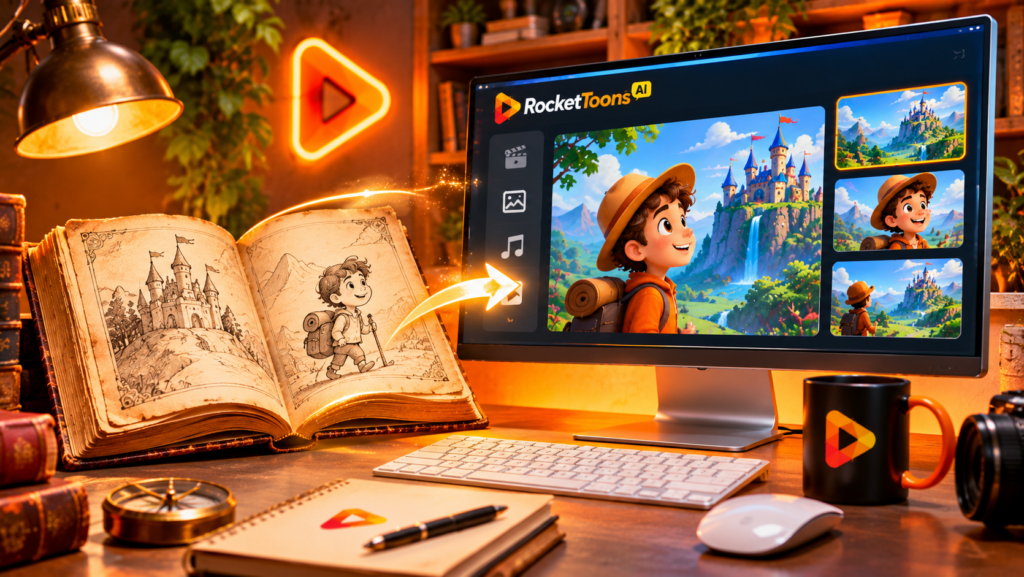
Yes, you can turn public-domain stories into AI cartoon videos, provided you choose a story that is genuinely in the public domain and respect the rights attached to any illustrations, adaptations, music, or other material you use. Classic fairy tales, folklore, fables, and older literary works can provide excellent starting points for animated storytelling. With an AI-assisted cartoon creation platform such as RocketToons AI, you can explore turning a written story into characters, scenes, dialogue, and an animated video.
Imagine bringing a classic tale to life with colorful cartoon characters, expressive voices, animated environments, and background music. Instead of simply reading the story aloud, you can create a visual experience that introduces familiar characters to a new audience or presents an old story in a fresh creative style.
What Is a Public-Domain Story?
A public-domain story is a work that is not protected by copyright or whose copyright protection has expired. Depending on the country and applicable laws, this may allow people to copy, adapt, distribute, and create new versions of the original work without requesting permission from a copyright owner.
Examples of traditional stories and older works that may have public-domain versions include:
- Classic fairy tales: Traditional stories such as Cinderella, Snow White, and Sleeping Beauty.
- Fables: Stories associated with Aesop, including The Tortoise and the Hare.
- Traditional folklore: Stories passed down through generations in different cultures.
- Classic literature: Older novels, short stories, and literary works whose copyright has expired in the relevant jurisdiction.
- Traditional legends: Folktales and mythological stories that can inspire original animated adaptations.
However, an important distinction exists: the original story may be in the public domain while a modern retelling, illustration, film adaptation, translation, or soundtrack remains copyrighted.
Why Turn Public-Domain Stories Into AI Cartoon Videos?
Public-domain stories offer creators a starting point for developing original animated content without necessarily having to invent an entirely new plot.
They can also appeal to audiences who already recognize familiar characters, themes, and lessons.
Here are some potential benefits:
- Established storytelling foundations: Many traditional stories already have a beginning, conflict, and conclusion.
- Educational opportunities: Classic fables and folktales can introduce moral lessons, cultural traditions, and historical themes.
- Creative flexibility: You can develop your own character designs, dialogue, visual style, and scene arrangements.
- Series potential: A collection of stories can become a recurring animated series.
- Multiple formats: A longer story can be adapted into a full video, shorter clips, or individual educational scenes.
The real opportunity is to add your own creative interpretation rather than simply reproducing an existing version.
How to Turn a Public-Domain Story Into an AI Cartoon Video in 7 Steps
Step 1: Choose a Story and Verify Its Copyright Status
Start by selecting a story that fits your intended audience. You might choose a short fable for a children’s educational video or a longer fairy tale for an animated storytelling series.
Before production, verify the copyright status of the specific version you intend to use. Copyright rules vary by country, and a story being old does not automatically mean every version of it is free to use.
Check the publication history, author, date, jurisdiction, and any applicable copyright terms. If you are unsure, seek appropriate legal guidance before commercial publication.
Step 2: Create Your Own Adapted Script
Once you have selected a suitable source, prepare a script for your cartoon video.
You can preserve the central plot while adapting the language, dialogue, pacing, and scene structure for your audience.
For example, a traditional fable could be rewritten with:
- A short opening that introduces the main characters.
- Simple dialogue that explains the conflict.
- Visual actions that move the story forward.
- A clear ending that communicates the lesson.
Make sure your script is an original adaptation rather than a copy of a copyrighted modern retelling.
Step 3: Design the Cartoon Characters
Identify the main characters and decide how they should look and behave. Write descriptions covering their appearance, clothing, personality, and role in the story.
For a story such as The Tortoise and the Hare, you might create a determined tortoise and an energetic rabbit with contrasting personalities.
Give each character a recognizable visual identity. If the character appears in several scenes, use consistent descriptions and references to reduce unwanted changes in appearance.
Step 4: Divide the Story Into Animated Scenes
Break the adapted script into individual scenes. Each scene should communicate one important action, event, or conversation.
For example, a cartoon adaptation of The Tortoise and the Hare might include:
- Scene 1: Introduce the rabbit and tortoise in a forest.
- Scene 2: The rabbit challenges the tortoise to a race.
- Scene 3: The race begins, and the rabbit runs ahead.
- Scene 4: The rabbit stops to rest while the tortoise keeps moving.
- Scene 5: The tortoise reaches the finish line.
- Scene 6: The characters reflect on the lesson of the story.
This structure gives you a practical production plan and makes it easier to create the animation in manageable sections.
Step 5: Choose an Animation Style and Add Voices
Select a visual style that suits the story and audience. Colorful storybook animation may work well for young children, while a more detailed cartoon style may suit a general storytelling channel.
Next, decide whether the story needs a narrator, individual character voices, or a combination of both.
Choose voices that match the characters and make the dialogue easy to understand. Preview the spoken lines and check pronunciation, pacing, and emotional delivery.
Step 6: Add Music and Sound Effects
Use background music to establish the atmosphere and sound effects to emphasize important actions.
A playful soundtrack may suit a humorous fable, while gentle music could work better for a thoughtful story. Footsteps, animal sounds, environmental effects, and transition sounds can add detail when they support the action.
Make sure that any music or sound effects you use are properly licensed. A public-domain story does not automatically make a modern soundtrack or sound recording public domain.
Step 7: Review and Export Your Cartoon Video
Watch the complete animation before publishing. Check character consistency, scene order, dialogue, sound quality, and whether the story makes sense to someone unfamiliar with your script.
Correct any confusing scenes and remove unnecessary repetition. You can then export the video in a format suitable for your intended platform, such as a horizontal YouTube video or a vertical short-form clip.
How RocketToons AI Can Help With Public-Domain Story Adaptations
RocketToons AI is advertised as an AI-powered cartoon video creation platform that brings together script assistance, character customization, scene development, AI voices, and video production.
These capabilities may be useful when adapting a public-domain story. You can start with your adapted script, identify the characters, plan the scenes, develop the cartoon visuals, and add dialogue and soundtrack elements.
The advertised workflow also includes storyboard previews and scene-level adjustments, which can help you review how the story is being translated into animation.
For example, you could develop a series of short animated fables, using a consistent visual style and recurring narrator while giving each story its own characters and setting.
Remember that AI assistance does not establish copyright permission. You remain responsible for checking the source material, modern adaptations, images, audio, and other assets used in your finished production.
To explore the platform’s advertised features, workflow, and buying considerations, read our complete RocketToons AI review.
Important Copyright Checks Before Publishing
Before turning a classic story into a public video or commercial project, check these important points:
- Original story: Confirm that the specific text you are adapting is in the public domain.
- Modern adaptations: Avoid copying protected dialogue, character designs, or distinctive elements from recent films and books.
- Illustrations: Create your own visuals or use images with appropriate permissions.
- Translations: A recent translation may have its own copyright even when the original story is public domain.
- Music and audio: Verify the license for each soundtrack and sound effect.
- Commercial use: Check the terms of your animation platform and every third-party asset you include.
These checks matter because copyright protection can apply to a particular adaptation even when the underlying story is free to use.
FAQs About Turning Public-Domain Stories Into AI Cartoon Videos
Can I make cartoon videos from public-domain fairy tales?
Yes, provided the specific story version you use is in the public domain in the relevant jurisdiction. You can create your own script, character designs, scenes, and animated adaptation.
Can I monetize AI cartoon videos based on public-domain stories?
Potentially, yes. You must have the necessary rights to all the material used, follow the relevant platform monetization policies, and add sufficient original creative value. Public-domain status alone does not guarantee monetization approval.
Can I use Disney versions of public-domain fairy tales?
You should not assume that you can copy elements from a modern film adaptation simply because the underlying fairy tale is public domain. Modern character designs, dialogue, music, and other distinctive creative elements may be protected.
Can I create a cartoon series using classic fables?
Yes. You can adapt different public-domain fables into separate episodes, develop a consistent visual identity, and use recurring narrators or original characters to connect the series.
Do I need permission to change a public-domain story?
Generally, you can create your own adaptation of a genuinely public-domain work without seeking permission from the original copyright owner. However, you must still avoid copying protected elements from later versions and comply with applicable laws.
Final Thoughts: Give Classic Stories a New Animated Life
Public-domain stories can provide a valuable foundation for animated storytelling. From traditional fairy tales and folklore to classic fables, they offer familiar plots that can be reimagined through original characters, fresh dialogue, expressive voices, and creative cartoon scenes.
The key is to verify the rights, write your own adaptation, and add meaningful creative value. AI tools can help with parts of the production process, but thoughtful storytelling and careful review are what make the finished video worthwhile. If you want to explore an AI-assisted way to develop cartoon characters, scenes, voices, and videos, take a closer look at RocketToons AI through our RocketToons AI review.