
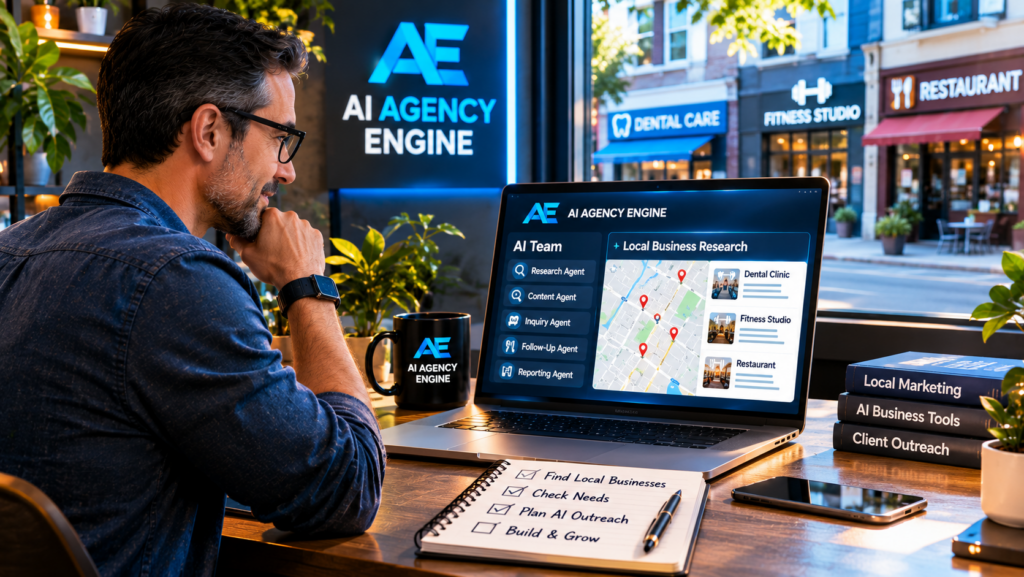
To start an AI agency for local businesses, choose a specific business niche, identify a problem that AI can help solve, build a focused service using AI teams, and demonstrate its potential value to business owners. You do not need to begin by creating a complicated collection of AI agents. Start with one useful service, learn how to deliver it reliably, and use tailored demonstrations to open conversations with potential clients. This is the practical approach explored in AI Agency Engine and its AI team training.
What Is an AI Agency for Local Businesses?
An AI agency helps businesses use artificial intelligence to support tasks such as customer communication, enquiry handling, content preparation and repetitive administration. Instead of selling AI technology for its own sake, an agency identifies a business need and proposes a service that addresses it.
Local businesses can be a useful market to explore because many depend on customer enquiries, appointments, service information and regular communication. Your job is to discover whether a particular business has a process that could genuinely benefit from an AI-assisted workflow.
How to Start an AI Agency in Five Steps
1. Choose a Local Business Niche
Begin with one type of business rather than trying to serve every industry. You could research home service providers, professional firms, local retailers or other service-based businesses.
Look for a niche where you can understand the customer journey and identify recurring tasks. Consider how businesses receive enquiries, answer common questions, organize leads and communicate with customers.
Choosing a focused niche makes it easier to understand the problems you are trying to solve and create demonstrations that feel relevant to business owners.
2. Identify One Problem Worth Solving
Research the businesses in your chosen niche and examine their websites from a potential customer’s perspective. Look at their service descriptions, contact options, enquiry process and frequently asked questions.
Then identify a possible improvement. For example, a business receiving repeated questions about its services might benefit from an AI-assisted information workflow. Another company might need help organizing incoming enquiries.
Do not assume that every business needs AI. Speak with the owner, understand the existing process and establish whether your proposed service would provide practical value.
3. Build a Focused AI Team
AI teams can help organize different responsibilities through specialist assistants rather than relying on one general-purpose chatbot for every task.
AI Agency Engine introduces Murage, a desktop application built around a Chief of Staff that coordinates specialist AI bots. Its ready-made AI team library is intended to help participants import and adapt existing teams instead of building every assistant from scratch.
For your agency, think about the tasks involved in delivering one service. You might use separate assistants to support research, prepare information, draft customer responses or organize work. Define each assistant’s role clearly and review its output before using it in a client-facing process.
4. Create a Demonstration for a Potential Client
A demonstration can make an AI service easier for a business owner to understand. Rather than describing a technical solution in abstract terms, show an example connected to the business’s actual needs.
The Demo Machine described in AI Agency Engine is designed to help create a tailored example for a potential local business client. For instance, you could demonstrate how an AI-assisted workflow might handle routine service questions or help organize enquiries.
Be transparent about what the demonstration does. A prototype is not the same as a fully implemented system, and you should never imply that a business is already using a solution when it is only an example.
5. Approach Prospects and Develop the Service
Use the demonstration as a starting point for a professional conversation. Explain the problem you noticed, show the example and ask whether the proposed improvement would be useful.
If the business is interested, discuss the scope, implementation requirements, pricing, data handling and ongoing support. Agree on what the service will and will not do before starting work.
After implementation, test the workflow carefully and monitor whether it continues to meet the client’s requirements. Reliable delivery and ongoing support are essential parts of an agency service.
How Do AI Teams Help an Agency?
A coordinated AI team can help divide work into manageable responsibilities. A central coordinator can organize tasks, while specialist bots support particular activities. This structure may help with research, planning, content preparation and repeatable administrative workflows.
However, AI teams do not replace business judgment. You remain responsible for checking accuracy, protecting client information, managing permissions and ensuring that automated processes behave as expected.
What Tools and Resources Do You Need?
- AI team application: A platform such as Murage can provide a desktop environment for coordinating specialist AI assistants. Murage is offered free, although connected AI providers and services may cost extra.
- Ready-made AI teams: Existing team structures can provide a starting point for configuring assistants around specific tasks.
- Demonstration workflow: A tool such as the AI Agency Engine Demo Machine can help prepare tailored examples for potential clients.
- Niche research resources: Money Maps are presented in the training as a way to explore possible markets and local business opportunities.
To understand how these resources fit into the wider training, including its features and advertised pricing, read the complete AI Agency Engine review.
Common Mistakes to Avoid When Starting an AI Agency
- Offering too many services: Start with one focused solution and expand when you understand what clients need.
- Automating without a clear purpose: Use AI to address a genuine business problem, not simply because automation is possible.
- Skipping testing: Check outputs and workflows before allowing them to handle real customer interactions.
- Ignoring operating costs: Include AI provider usage, integrations and maintenance when calculating service costs.
- Expecting automatic clients: Prospecting, communication and relationship-building remain necessary.
Frequently Asked Questions
Can beginners start an AI agency for local businesses?
Yes. Beginners can start by learning one AI-assisted workflow and developing a focused service. Software setup, testing and client communication still require time and practice.
Do I need coding skills to start an AI agency?
You can explore AI-assisted services without beginning as a software developer, but you should be comfortable learning tools, following setup instructions and understanding how your chosen workflows operate.
What services can an AI agency offer local businesses?
Possible services include routine enquiry support, customer communication assistance, lead organization, content preparation and repetitive administrative workflows. Choose services based on actual client needs.
Can AI teams find clients automatically?
AI teams can support research and preparation, but they do not guarantee customers. You still need to identify prospects, make contact, demonstrate value and agree on suitable projects.
Final Thoughts
Starting an AI agency for local businesses is best approached as a focused service business: choose a niche, identify a real problem, build an appropriate AI-assisted workflow, demonstrate its value and deliver it responsibly. AI teams can help organize the work, but your understanding of the client’s needs is what makes the service relevant.
AI Agency Engine brings together Murage, ready-made AI team resources, the Demo Machine and training around this approach. For a closer look at the complete offer, its pricing, bonuses and features, visit the AI Agency Engine review and full offer breakdown.