
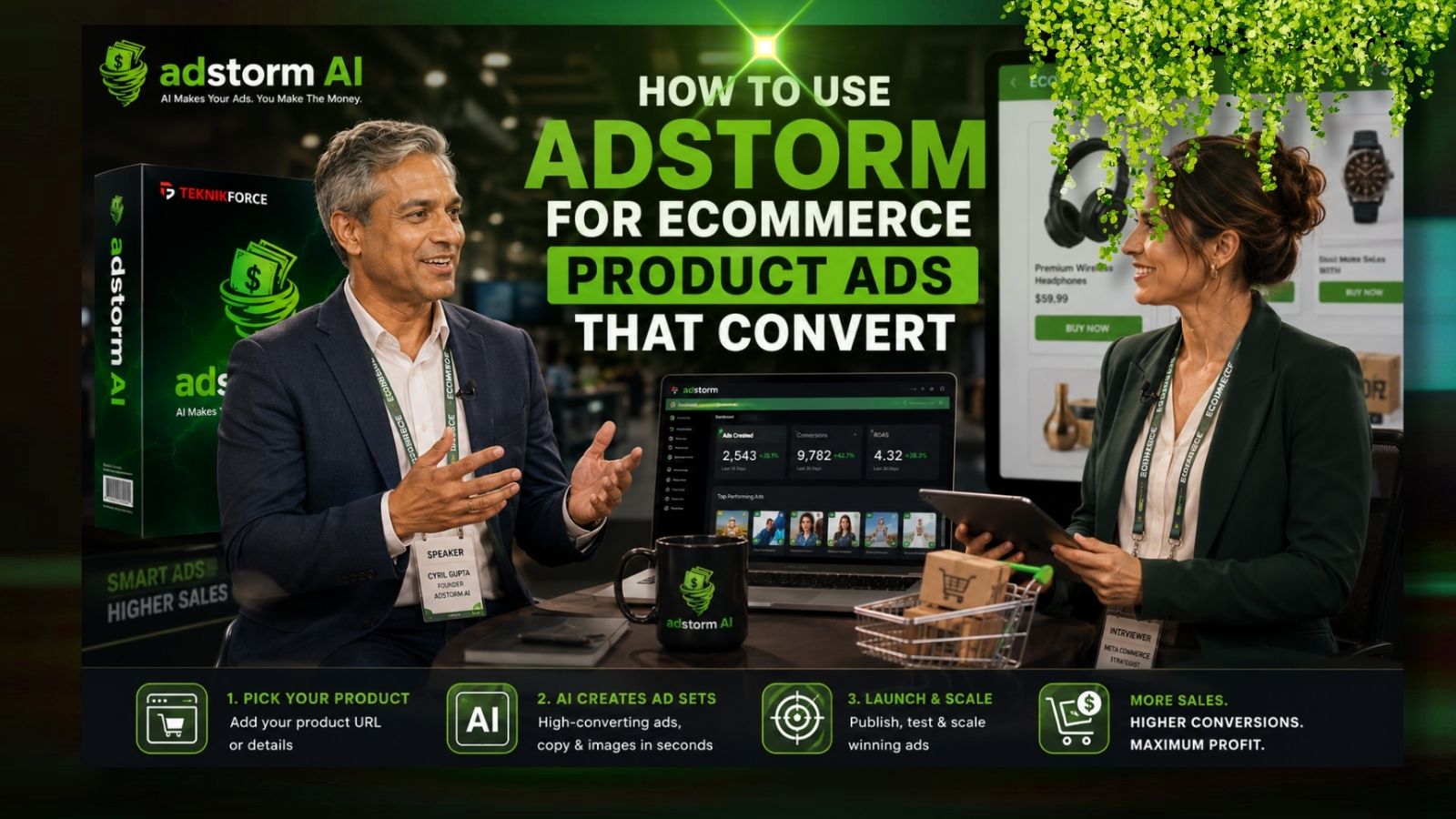
Running ecommerce ads in 2026 is no longer just about having a good product.
Even great products fail when the ads are weak.
Many ecommerce store owners struggle with expensive CPMs, poor click-through rates, creative fatigue, and low conversions. Worse, creating fresh ads constantly can become exhausting—especially when every new campaign requires designers, copywriters, or expensive agencies.
That’s why many marketers are now exploring Adstorm ecommerce ads as a faster way to create product promotions that actually convert.
In simple terms, Adstorm helps ecommerce sellers generate ad creatives, headlines, hooks, product mockups, and ad variations quickly so they can test more campaigns without needing a full creative team.
Why Do Most Ecommerce Ads Fail To Convert?
Many ecommerce ads fail because they focus too much on the product and not enough on the customer problem.
For example, selling a fitness blender is not really about the blender.
It is about:
- Saving time in the morning
- Eating healthier
- Losing weight faster
- Feeling more energetic
Here’s what actually matters:
High-converting ecommerce ads sell outcomes—not products.
This is where Adstorm ecommerce ads can help.
Instead of guessing what messaging works, Adstorm generates multiple creative angles, headlines, and ad concepts designed for different customer emotions and buying triggers. According to the platform, it supports ecommerce campaigns across Facebook, Instagram, TikTok, Google, and YouTube.
How Can You Create Ecommerce Product Ads With Adstorm?
The process is designed to be beginner-friendly.
Step 1: Add Your Product Or Website URL
Most ecommerce businesses already have product pages.
Instead of manually designing ads from scratch, users can input their website URL or product information.
Adstorm then helps generate:
- Product ad creatives
- Headlines
- Promotional copy
- CTA suggestions
- Product mockups
- Multiple ad angles
This saves serious time.
Instead of spending hours brainstorming ideas, ecommerce brands can launch campaigns much faster.
Step 2: Create Multiple Creative Angles
One of the biggest mistakes ecommerce brands make is relying on only one message.
However, different customers buy for different reasons.
For example, imagine you sell a portable blender.
Adstorm might generate angles like:
Convenience Angle
“Healthy smoothies in under 60 seconds.”
Lifestyle Angle
“Stay fit even during busy mornings.”
Pain Point Angle
“Tired of skipping breakfast every day?”
Transformation Angle
“Feel healthier without changing your routine.”
The key idea is simple:
More creative testing usually leads to better performance.
Step 3: Create Scroll-Stopping Visuals
Ecommerce ads are visual-first.
People scrolling Facebook, Instagram, or TikTok decide within seconds whether they care.
Therefore, visuals matter more than ever.
Adstorm helps generate:
- Product-focused creatives
- Promotional ad designs
- UGC-style visuals
- Mockups
- Platform-specific ad formats
This can help ecommerce sellers avoid one of the biggest problems in advertising:
Creative burnout.
Instead of reusing the same ad repeatedly, sellers can continuously refresh campaigns.
Why Are Adstorm Ecommerce Ads Useful For Facebook And Instagram?
Meta’s advertising system increasingly rewards creative testing.
In fact, many successful brands win simply because they test more ads faster.
However, creating fresh creatives manually is expensive.
This is where Adstorm ecommerce ads become practical.
Instead of hiring:
- Graphic designers
- Video editors
- Copywriters
Users can generate multiple ad versions internally.
For ecommerce businesses running paid traffic daily, this speed advantage matters.
If you want a broader understanding of how the platform works overall, you can also check the complete Adstorm review and feature breakdown.
Can Beginners Use Adstorm For Ecommerce Advertising?
Yes.
In fact, beginners may benefit the most.
Many new ecommerce sellers struggle with:
“What should my ad say?”
“How do I design professional creatives?”
“What headline actually converts?”
Adstorm simplifies much of the process.
Instead of starting with a blank page, users receive AI-generated ideas they can test immediately.
However, there are still a few fundamentals beginners should remember.
What Makes Ecommerce Ads Convert Better?
Strong Product Hook
People need a reason to stop scrolling.
Clear Benefits
Focus on outcomes—not features.
Customer Pain Points
Show how the product solves a problem.
Fast Testing
Winning ads usually come from multiple experiments.
Adstorm helps speed up all four.
Is Adstorm Better Than Canva For Ecommerce Ads?
This depends on your workflow.
Canva is great for manual designing.
However, Adstorm focuses more on speed, automation, and ad testing.
Instead of designing one creative manually, ecommerce sellers can create multiple ad variations quickly.
Therefore, for brands that rely heavily on paid traffic, Adstorm may offer a faster workflow.
That said, many marketers may find the best approach is combining both:
Adstorm for speed + Canva for refinements.
Final Thoughts On Adstorm Ecommerce Ads
Creating ecommerce ads that convert does not need to feel overwhelming anymore.
The biggest takeaway is this:
Successful brands often win because they test more creative angles faster—and that is exactly what Adstorm ecommerce ads help simplify.
If you want to understand the platform in greater detail, you can explore the full Adstorm breakdown here to see how the features work for ecommerce campaigns.
Or, if you prefer researching directly, you may want to visit the official Adstorm page and explore its ecommerce ad capabilities for yourself.
If you’d like extra help getting started, don’t forget to grab the free bonuses below, including additional marketing resources, practical ad strategies, and tools designed to help ecommerce campaigns perform better with Adstorm.