
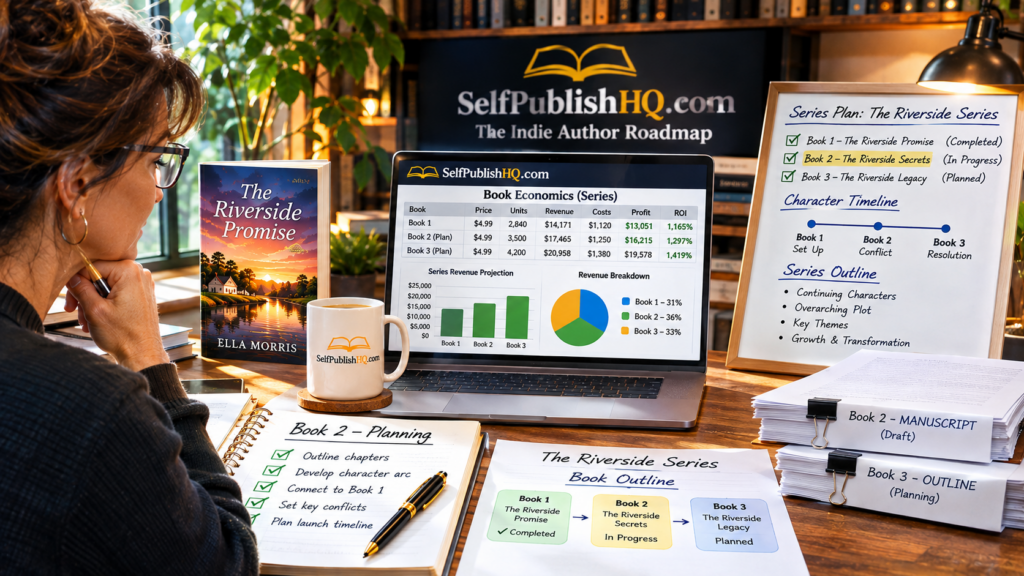
To plan Book 2 successfully, use Book 1 as the foundation: review its characters, world, unresolved plot threads and reader response, then develop a follow-up story that delivers a satisfying next experience while giving readers a reason to continue the series. A sustainable author series is built through continuity, consistent storytelling and a realistic publishing schedule—not simply by rushing another book onto Amazon. Resources such as SelfPublishHQ’s Book 2 Fast-Track are designed to help authors approach that next step with a more structured plan.
Why Book 2 Matters in a Self-Published Series
Your first book introduces readers to your writing, characters and fictional world. If readers enjoy that experience, a second book gives them an opportunity to return to something familiar while discovering what happens next.
For authors, a series can also create a more organised publishing direction. Instead of starting from a completely new concept every time, you can build on an established setting, audience and collection of characters.
However, Book 2 must work as a meaningful reading experience. It should develop the series rather than feel like an unfinished extension of Book 1.
Step 1: Review Book 1 Before Planning the Sequel
Before writing the next instalment, revisit your first book and identify the elements that should carry forward.
- Characters: Record each major character’s personality, motivations, relationships and development.
- World and setting: Document locations, rules, important objects and established details.
- Unresolved questions: List mysteries, conflicts and promises that have not yet been resolved.
- Character arcs: Identify what changed during Book 1 and what still needs development.
- Series direction: Consider the larger story you want readers to experience across multiple books.
A Series Bible is particularly useful here. It acts as a reference document that helps prevent continuity problems when you return to the same fictional world months later.
Step 2: Decide What Book 2 Needs to Accomplish
A sequel needs its own central conflict, purpose and progression. Simply repeating the structure of Book 1 with a different problem can make the series feel predictable.
Ask yourself these questions:
- What important consequence from Book 1 should influence the next story?
- How have the main characters changed since the opening of the first book?
- What new challenge can test those characters?
- Which unresolved plot threads should be developed or answered?
- What new information will make the wider series more interesting?
Try writing a one-paragraph premise for Book 2 before creating a detailed outline. This helps establish a clear direction without committing prematurely to every scene.
Step 3: Balance Continuity With a Fresh Story
Readers want to recognise the world and characters they enjoyed in Book 1, but they also expect something new. The challenge is to preserve the series identity while allowing the story to evolve.
Maintain established character voices, relationships and world rules. At the same time, introduce new conflicts, settings, discoveries or supporting characters that move the narrative forward.
Avoid making Book 2 depend entirely on readers remembering every detail of the first instalment. Include enough context for returning readers to reconnect with the story, without repeatedly explaining information they already know.
Step 4: Build a Practical Book 2 Outline
Once the premise is clear, create a chapter or scene outline. It does not need to be complicated. Its purpose is to give you a workable structure before drafting begins.
For each chapter or major scene, note:
- What happens?
- Which characters are involved?
- What changes as a result?
- How does the scene contribute to the central conflict?
- Does it connect logically with the established series continuity?
If you use ChatGPT or Claude, provide your Series Bible and outline as reference material. Ask the AI to identify possible continuity conflicts before generating new scenes. Treat its suggestions as material to review, not decisions that automatically become part of your story.
Step 5: Plan a Realistic Writing and Publishing Schedule
A sustainable series requires a workflow you can maintain. Set a writing target that reflects your available time, manuscript length and other responsibilities.
Break the project into manageable milestones: outline completion, first draft, revision, editing, cover preparation and publication. Leave room for unexpected delays rather than promising readers a release date you may struggle to meet.
Consistency is more useful than an unrealistic schedule that leads to rushed manuscripts or burnout.
Step 6: Use Book 1 to Inform Your Series Strategy
Book 1 can provide useful information about how readers respond to your work. Review reader feedback, common comments and questions, and any recurring points of confusion. Use that information to improve the next instalment without allowing a small number of opinions to dictate the entire creative direction.
Also consider the commercial side of your series. Think about pricing, production costs, royalties and the assumptions behind future-book sales. A realistic series plan should account for the time and resources required to create each instalment.
How SelfPublishHQ Helps You Plan Book 2
SelfPublishHQ includes a Book 2 Fast-Track resource in its GROW stage. It is designed to help authors move from their first published book towards planning the next instalment. The wider GROW resources also include a Series Bible Template and Series Economics Calculator, which support continuity planning and the evaluation of series-related financial assumptions.
These resources are intended to help authors build on the work already completed rather than approach every new book as an entirely separate project. The complete SelfPublishHQ review and seven-stage roadmap explains how the Book 2 resource fits into the wider author workflow.
Frequently Asked Questions
Should Book 2 continue directly from Book 1?
It depends on your genre and series structure. Some stories continue immediately, while others include a time jump. The important thing is to preserve continuity and deliver a satisfying next instalment.
How soon should I publish Book 2?
There is no universal schedule. Choose a realistic timeframe that allows you to write, revise, edit and package the sequel to an appropriate standard.
Do I need a Series Bible for Book 2?
It is highly useful, particularly when your series includes recurring characters, complex relationships, detailed settings or multiple unresolved plot threads.
Can AI help me write a sequel?
Yes. AI tools can help with outlining, brainstorming and drafting, but you should supply established story details and personally review the output for continuity, originality and quality.
Final Thoughts: Turn Book 1 Into the Foundation for a Series
Planning Book 2 starts with understanding what Book 1 established and deciding where the story should go next. Review your characters and world, identify unresolved threads, develop a fresh central conflict and create a realistic writing schedule. With a clear plan, your first book can become the foundation for a more sustainable author series. To see how Book 2 planning fits into the complete self-publishing process, read the full SelfPublishHQ review.