
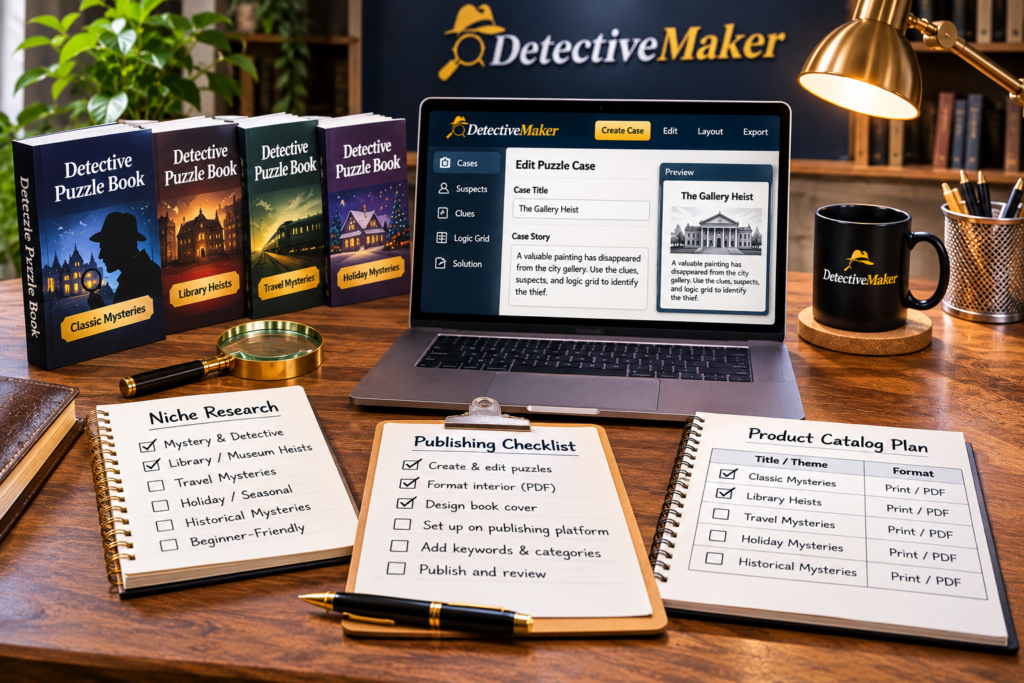
Yes, Detective Maker can help you build a detective puzzle book business by simplifying the creation of mystery stories, suspects, clues, deduction grids, and solutions that can be developed into products for sale. It provides AI-assisted puzzle generation, visual editing tools, multiple language options, and an advertised commercial license. However, the software is a content creation tool, not a complete business-in-a-box: you still need to validate puzzles, prepare professional books, research your market, and attract customers. You can explore Detective Maker here if you want to examine its features.
How Can Detective Maker Help You Start a Puzzle Book Business?
Detective Maker is designed to create detective-style deduction puzzles using AI. A generated case can include a mystery story, suspects, weapons, locations, clues, evidence, a deduction grid, and a solution.
These elements provide the foundation for products such as printable mystery puzzles, detective activity books, and themed logic puzzle collections. Instead of developing every case and puzzle component manually, you can use the software to generate a starting point and then edit the content before publishing.
Its visual editor also provides controls for modifying generated content and arranging puzzle pages. This can help organize the material into a more consistent product.
What Detective Puzzle Products Could You Create?
A detective puzzle business does not have to rely on a single type of book. You can explore different product formats and themes based on the readers you want to reach.
- Detective puzzle books: Collections of mystery cases with clues, deduction grids, and answer sections.
- Printable mystery puzzles: Individual cases or small collections packaged as digital downloads.
- Themed detective collections: Books built around settings such as museums, country houses, hotels, or fictional towns.
- Difficulty-based puzzle books: Beginner, intermediate, and more challenging collections, provided each puzzle is tested carefully.
- Multilingual puzzle products: Editions in supported languages for creators interested in reaching different audiences.
The best starting point is usually one clearly defined product for a specific audience. This makes it easier to assess customer interest before expanding your catalogue.
Step 1: Choose Your Niche and Target Customer
Before generating puzzles, decide who you want to sell to. Your audience could include adults who enjoy logic challenges, mystery fans, families looking for activities, or readers interested in detective-themed puzzle books.
Research competing products and consider what could make your collection distinctive. You might focus on a particular mystery theme, a consistent visual style, or a carefully planned progression from easier to more difficult cases.
A clear product concept gives your book a stronger identity than simply publishing a random collection of AI-generated puzzles.
Step 2: Generate and Develop Your Puzzles
Use Detective Maker to generate the building blocks of your cases. Start with a theme and create the stories, suspects, clues, evidence, deduction grids, and solutions needed for your collection.
Do not assume that generated content is automatically ready to sell. Check every mystery for logical consistency. Make sure the clues support the intended answer, the grid agrees with the story, and the written solution does not contradict the evidence.
Try solving each puzzle without looking at its answer. If possible, ask another person to test it independently. This is particularly important when creating a larger collection because one confusing puzzle can affect the reader’s experience of the entire book.
Step 3: Edit and Prepare a Professional Product
Detective Maker includes a visual editor and page-management controls. You can work with book size, margins, page numbering, solution display, and additional pages. The Plus edition adds expanded styling and project-saving controls, while Premium offers more extensive customization of puzzle and solution blocks.
Use these features to create a consistent reading experience. Keep instructions clear, grids readable, and answer sections easy to find. Review every page at its intended print size to catch layout problems before publishing.
Remember that a polished product requires more than generated puzzle content. Proofreading, formatting, cover design, and clear instructions all contribute to the finished result.
Step 4: Choose Where to Sell Your Books
Detective puzzle products can be developed for different selling channels, depending on their format and your business model.
- Amazon KDP: Consider publishing completed detective puzzle books as print products.
- Etsy: Explore selling finished printable puzzle collections as digital products.
- Your own website: Build a catalogue of detective puzzle products and promote them to your audience.
Detective Maker advertises a commercial license, which is relevant to creators who intend to sell their finished work. Always review the actual license terms and follow the publishing platform’s current content and intellectual-property policies. Commercial rights do not guarantee approval or sales.
Step 5: Build a Repeatable Publishing Workflow
A sustainable puzzle book business needs a process that you can repeat without sacrificing quality. Start with a small collection, test the production workflow, and record how much time you spend generating, checking, editing, formatting, and preparing each product.
Once you understand the process, you can develop additional themes, improve your layouts, and create new editions based on customer feedback. Research keywords and competing listings before choosing your next product idea. Avoid assuming that publishing more books automatically leads to more sales.
For a closer look at Detective Maker’s features, pricing, editions, and advertised bonuses, read the complete Detective Maker review.
What Are the Limitations to Consider?
Detective Maker can assist with puzzle creation, but it does not handle every part of running a publishing business. You remain responsible for:
- Checking the accuracy and solvability of generated puzzles.
- Proofreading stories, clues, instructions, and solutions.
- Preparing covers and publication-ready files.
- Researching customer demand, competition, and pricing.
- Creating product listings and marketing your books.
- Understanding any additional AI usage costs associated with your chosen generation method.
These responsibilities matter because a business depends on the quality and appeal of the finished products, not simply on how quickly content can be generated.
Who Should Consider Detective Maker?
Detective Maker may suit aspiring puzzle book publishers, self-publishing entrepreneurs, Etsy printable sellers, and mystery enthusiasts interested in turning puzzle concepts into commercial products. Its multiple language options may also appeal to creators exploring different audiences.
It is less suitable for someone expecting guaranteed income, completely automated publishing, or puzzles that never require manual review.
Final Verdict: Can Detective Maker Help Build a Business?
Yes, Detective Maker can provide useful puzzle-generation and editing tools for building a detective puzzle book business. It can help create mystery cases, organize puzzle components, and prepare content for products such as books and printables. Its advertised commercial license also makes it relevant to creators planning to sell their finished work.
The business opportunity still depends on choosing the right audience, producing logically sound puzzles, creating professional products, and marketing them effectively. Treat Detective Maker as a tool that can support your publishing workflow rather than a guarantee of business success. To examine its features, pricing, upgrades, and bonuses before making a decision, read the full Detective Maker review.