One of the most common questions authors ask after publishing a book is surprisingly simple.
What should I post about my book?
For many writers, this question becomes a major obstacle. Writing the book itself may feel natural, but creating a steady stream of promotional content often does not.
Authors suddenly find themselves expected to produce social media posts, promotional graphics, blog articles, and reader engagement content. All of this must be done regularly to maintain visibility.
That is why a growing number of authors are asking whether artificial intelligence can generate marketing content automatically.
The answer is yes, but the way it works may be different from what many people expect.
Why Do Authors Struggle to Create Marketing Content?
The difficulty is rarely about creativity.
Most authors have plenty to say about their subject or story. The challenge lies in converting that knowledge into consistent promotional material.
Marketing content requires a slightly different mindset than writing a book. Social media posts must be short and engaging. Blog articles must connect with search intent. Visual content must capture attention quickly.
For authors who primarily enjoy long form writing, these marketing formats can feel unfamiliar.
As a result, many writers delay promotion or stop altogether because they simply run out of ideas.
This gap between writing and marketing is exactly where AI tools have started to play an important role.
How Does AI Create Marketing Content From a Book?
Modern AI systems can analyze large blocks of text and identify key themes, concepts, and memorable phrases.
When applied to a book manuscript, this capability allows AI to extract meaningful elements from the content itself.
For example, the system may identify quotes, discussion points, insights, or storytelling elements that can be turned into promotional material.
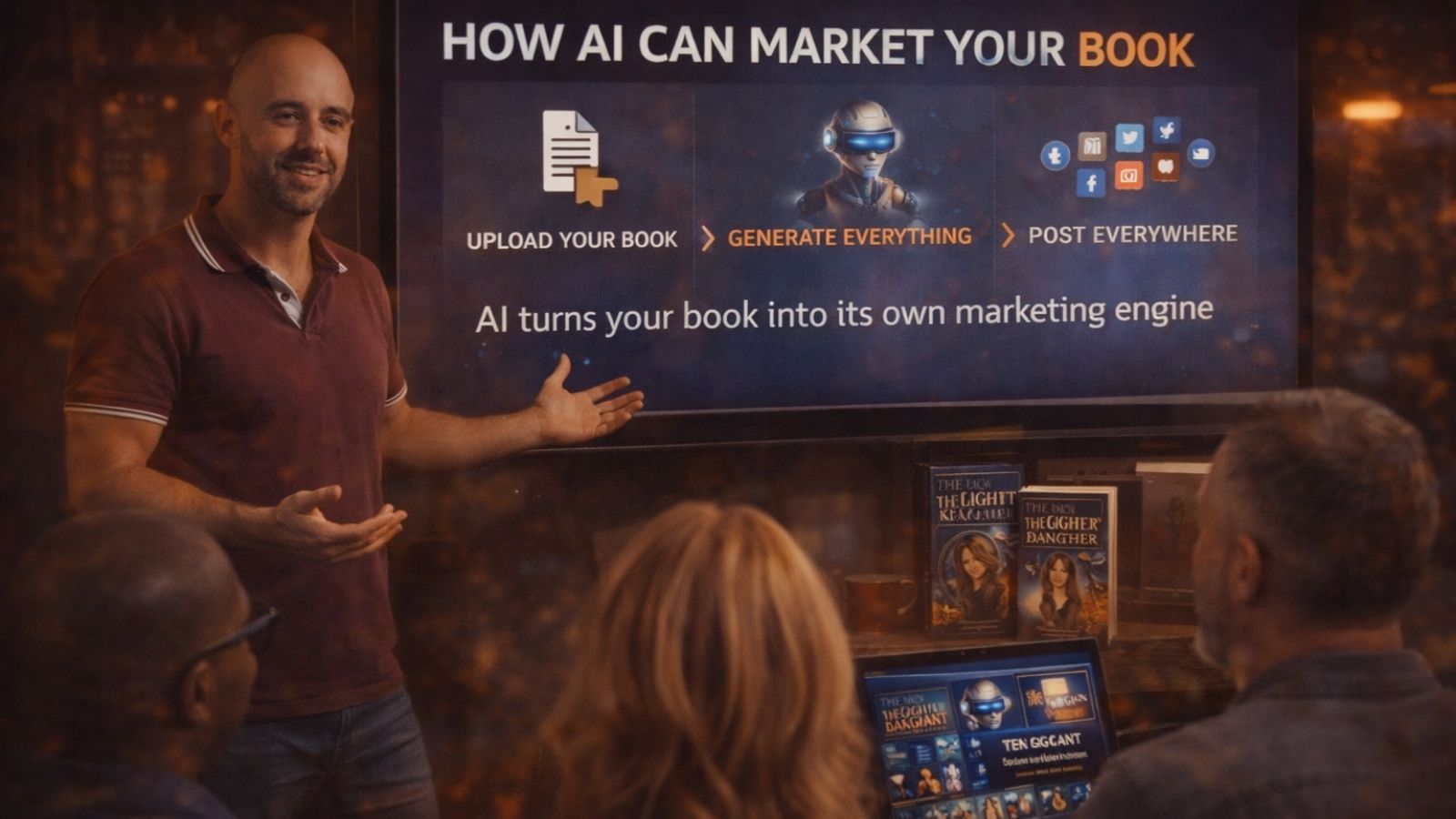
From these elements, the AI can generate several types of marketing content. This may include short captions, social media posts, blog style articles, or engagement questions designed to spark conversation.
Instead of requiring the author to manually brainstorm ideas, the system uses the book as the source material for marketing.
This approach ensures that promotional content remains closely connected to the actual message of the book.
Can AI Content Still Feel Authentic to Readers?
One concern authors often express is whether AI generated marketing will feel generic.
This concern is understandable. Early AI writing tools often produced content that felt repetitive or disconnected from the original material.
However, newer systems are designed to work directly from the manuscript rather than from generic prompts.
Because the AI analyzes the book itself, the resulting promotional content is usually grounded in the author’s ideas, tone, and subject matter.
The author still retains control over the final content. Generated posts can be edited, refined, or expanded before being published.
In practice, many authors treat AI generated marketing content as a starting point rather than a finished product.
This hybrid approach allows writers to maintain authenticity while reducing the time required to generate ideas.
Why Is Content Generation Only One Part of the Marketing Process?
Creating promotional material is only the first step.
The second challenge is distribution.
Once content is created, it still needs to be published consistently across multiple platforms where readers spend time. Managing these platforms manually often becomes the most time consuming part of book marketing.
Some AI marketing platforms attempt to solve both problems at once. They generate promotional content from the manuscript and then distribute that content across connected social media accounts.
AI Sales Rocket is one example of a platform designed around this workflow. It reads the manuscript, creates promotional content, and publishes posts across multiple platforms automatically.
If you want to understand how that system operates in more detail, the full explanation is covered in this AI Sales Rocket software review, pricing breakdown, and demo walkthrough
Can AI Generated Content Actually Improve Book Visibility?
Marketing content alone does not guarantee success.
However, consistent promotion often increases the chances that readers will discover a book. The more frequently a book appears across online platforms, the more opportunities readers have to encounter it.
AI content generation makes it easier to maintain this consistency.
Instead of waiting for inspiration to strike, authors can generate multiple promotional posts in a single session and schedule them over time.
This approach helps maintain ongoing visibility without requiring constant daily effort.
Is AI Marketing Replacing Human Creativity?
Not exactly.
Most experienced authors see AI as a support tool rather than a replacement for human creativity.
AI can generate ideas quickly, summarize concepts, and produce draft content. But authors still guide the overall message and ensure that the marketing aligns with their voice and brand.
In this sense, AI acts more like a collaborative assistant than an independent marketer.
For writers who want to spend more time creating books and less time brainstorming marketing content, this partnership can be particularly valuable.
Will AI Content Generation Become Standard for Authors?
The publishing landscape is evolving rapidly.
As competition increases and more books enter the market each year, visibility becomes more important than ever.
Automation tools and AI marketing systems are emerging as practical solutions for authors who want to maintain promotion without sacrificing writing time.
While AI will not replace traditional marketing entirely, it is likely to become an increasingly common part of the author’s toolkit.
For many writers, the question is no longer whether AI can generate marketing content.
The real question is how best to use it.
it.