
Introduction
Manual video editing has long been one of the biggest bottlenecks for marketers and creators. The learning curve is steep, the software is expensive, and even simple edits can take hours. With AI video tools becoming more capable, a natural question follows: can CineFlow AI actually replace manual video editing completely in 2026? In this article, we look at that question honestly, without hype, and evaluate where CineFlow AI succeeds, where it falls short, and what “replacement” really means in practical terms.
Read the full CineFlow AI Review to understand features, pricing, and real-world use cases
What Manual Video Editing Really Involves
To understand whether CineFlow AI can replace manual editing, it helps to define what manual editing actually includes.
Traditional video editing requires sourcing footage, arranging clips on a timeline, adding transitions, syncing audio, adjusting pacing, exporting multiple versions, and often revising based on feedback. Each step requires technical skill and time. Even experienced editors can spend hours polishing a short video.
For marketers and business owners, this process often becomes a productivity drain rather than a creative advantage.
What CineFlow AI Automates Well
CineFlow AI excels at automating repetitive and time-consuming parts of video creation. Instead of manually building a timeline, users provide structured text, scripts, or ideas, and the system assembles a complete video automatically.
Scene selection, pacing, transitions, and overall flow are handled by the platform. This eliminates the need for technical editing knowledge in most cases. For users producing content at scale, this automation alone can save significant time.
In marketing contexts, where speed and consistency matter more than artistic nuance, CineFlow AI covers the majority of required tasks.
Where CineFlow AI Cannot Fully Replace Editors
Despite its strengths, CineFlow AI does not replace manual editing in every scenario.
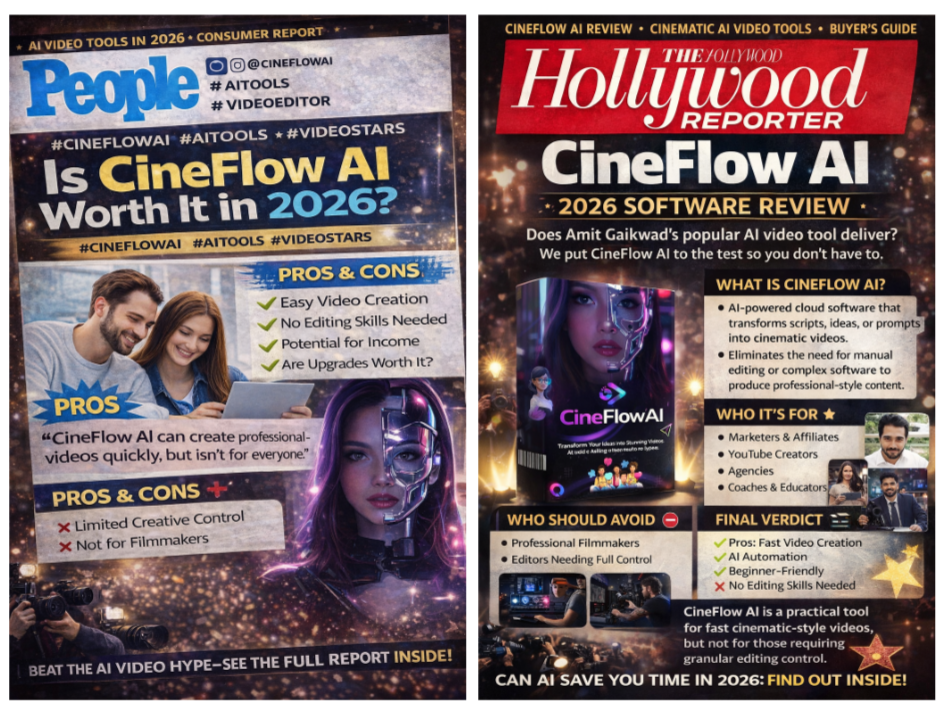
Professional editors often require frame-level control, custom color grading, detailed sound design, and narrative storytelling decisions that go beyond automation. CineFlow AI intentionally avoids this complexity to remain accessible.
If your work depends on cinematic storytelling, documentary production, or film-quality visuals, manual editing tools are still necessary.
This limitation is not a flaw, but a design choice aligned with CineFlow AI’s target audience.
Replacement vs Reduction: The More Accurate Perspective
A more accurate way to frame CineFlow AI’s role is reduction rather than replacement.
For marketers, affiliates, agencies, educators, and content creators, CineFlow AI can replace manual editing for a large percentage of use cases. Promo videos, explainer content, faceless YouTube videos, ads, and short-form social content can often be produced without touching traditional editing software.
In these cases, CineFlow AI effectively replaces the need for manual editing altogether.
For high-end creative work, CineFlow AI reduces workload by handling first drafts or base content that can be refined manually if needed.
Who Benefits Most From Replacing Manual Editing
CineFlow AI is most valuable to users who are not professional editors but still need video content regularly.
This includes affiliate marketers creating review videos, agencies delivering content for clients, YouTube creators running faceless channels, and business owners producing promotional material.
For these users, manual editing is often a barrier rather than a skill advantage. CineFlow AI removes that barrier.
Cost and Time Comparison
Manual editing software often comes with recurring subscription fees, training costs, and hardware requirements. In contrast, CineFlow AI offers a relatively low-cost entry point and does not require powerful machines.
From a time perspective, what might take hours in traditional software can often be completed in minutes with CineFlow AI. Over weeks or months, this difference compounds significantly.
For businesses, this time savings directly impacts productivity and scalability.
So, Can CineFlow AI Replace Manual Video Editing in 2026?
The honest answer is yes and no.
CineFlow AI can completely replace manual video editing for many business, marketing, and content-driven use cases. It cannot replace professional editing for cinematic or creative storytelling projects.
Understanding this distinction is key. CineFlow AI is not designed to be everything for everyone. It is designed to eliminate friction where manual editing is unnecessary.
Final Thoughts
If manual video editing feels like a bottleneck rather than a creative outlet, CineFlow AI offers a compelling alternative in 2026. It replaces complexity with automation and trades fine control for speed and consistency.
For the right user, that tradeoff is not only acceptable, it is advantageous.
See the complete CineFlow AI Review for pricing, upgrades, bonuses, and final verdict